
Deep Cleaning Teeth in Mississauga: Cost, Procedure, Disadvantages & CDCP Coverage (2026 Guide)
If your dentist or hygienist has told you that you need a “deep cleaning” instead of a regular cleaning, it’s natural to have questions — what actually happens, does it hurt, how much does deep cleaning teeth cost in Mississauga, and is it even worth doing? This guide answers every one of those questions in plain language: what a deep cleaning (scaling and root planing) actually is, the real disadvantages and side effects patients report, exactly what it costs in Ontario with and without insurance, and how the Canadian Dental Care Plan (CDCP) fits in.
Medically reviewed by Dr. Sahil Gagnani, DMD (McGill University), MDS (AIIMS) — general dentist at Eglinton Oak Dental, Mississauga. Last updated 2026.
Not Sure If You Need a Deep Cleaning?
We’ll check your gums, measure pocket depths, and give you an honest, upfront quote — no guesswork. Call 905-607-1112 or fill in the quick form below.
What Is a Deep Cleaning at the Dentist?
A deep cleaning — the clinical term is scaling and root planing — is a more thorough version of a regular cleaning used when plaque and tartar (hardened calculus) have built up below the gumline, inside the pockets that form between your teeth and gums once gum disease (periodontitis) sets in. A regular cleaning only removes plaque and tartar from the visible, above-the-gumline surfaces of your teeth. A deep cleaning goes further: it removes bacteria and tartar from below the gumline (“scaling”) and smooths the exposed root surfaces (“root planing”) so that inflamed gum tissue can heal and reattach more tightly to the tooth.
Dentists recommend a deep cleaning when a hygiene exam shows gum pockets deeper than about 4–5mm (measured with a small periodontal probe), bleeding on probing, visible tartar below the gumline, or bone loss on X-rays — all signs of periodontitis rather than simple gingivitis. It is not a cosmetic or optional “upsell” treatment; it is the standard, evidence-based first-line treatment for active gum disease before it progresses to tooth loss.
Deep Cleaning vs. Regular Cleaning: What’s the Difference?
The two procedures sound similar but treat different situations. Here’s a side-by-side comparison:
| Regular Cleaning | Deep Cleaning | |
|---|---|---|
| Also called | Prophylaxis, scale & polish | Scaling & root planing (SRP), periodontal cleaning |
| Who needs it | Healthy gums or mild gingivitis | Periodontitis (gum pockets ≥4–5mm) |
| Area treated | Above the gumline | Above and below the gumline, including root surfaces |
| Anesthesia | Not usually needed | Local anesthetic is common per section treated |
| Visits | One visit, ~30–45 minutes | Usually 2–4 visits, done by quadrant |
| Frequency | Every 6 months | Once, then periodontal maintenance every 3–4 months |
Signs You Might Need a Deep Cleaning
You may need a deep cleaning rather than a regular cleaning if you notice:
- Gums that bleed when you brush or floss
- Red, swollen, or tender gums
- Persistent bad breath that doesn’t go away with brushing
- Gums that appear to be pulling away from your teeth (recession)
- Teeth that feel slightly loose
- Visible tartar buildup near the gumline
- A change in how your bite feels, or new gaps forming between teeth
Many patients have no obvious symptoms at all — periodontitis is often painless in its earlier stages, which is exactly why we measure gum pocket depth at every checkup rather than relying on how your mouth feels.
The Deep Cleaning Procedure, Step by Step
Here’s what actually happens during a deep cleaning appointment at Eglinton Oak Dental:
1. Assessment and numbing
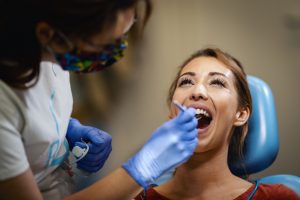
We first measure pocket depths around every tooth and review your X-rays, then apply a local anesthetic to the section of your mouth being treated that day so the process is comfortable, not painful.
2. Scaling
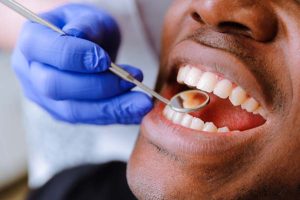
Using an ultrasonic scaler (a vibrating tip with a fine water spray) and hand instruments, we remove plaque and hardened tartar from both above and below the gumline, working carefully around each tooth root inside the gum pocket.
3. Root planing
Once the root surface is clean, we smooth it out. A smooth root surface makes it harder for bacteria to stick and re-colonize, and it gives your gum tissue the best possible surface to reattach to as it heals.
4. Rinse and, if needed, antimicrobial placement
The area is rinsed thoroughly, and in some cases a localized antibiotic gel is placed directly into deeper pockets to further reduce bacteria while healing occurs.
Because thoroughly treating an entire mouth in one sitting under local anesthetic is a lot for most patients, we typically split treatment into quadrants (upper-right, upper-left, lower-right, lower-left) over two to four appointments, usually about a week or two apart, rather than doing all four in a single visit.
How Long Does a Deep Cleaning Take?
Each quadrant appointment usually takes 45 minutes to an hour, including numbing time. If your case is treated as two half-mouth visits instead of four quadrant visits, expect closer to 60–90 minutes per appointment. Full treatment of all four quadrants is typically completed within a few weeks, not all in a single day.
Who Performs a Deep Cleaning?
At Eglinton Oak Dental, deep cleanings are performed by our registered dental hygienists working under the dentist’s diagnosis and treatment plan, with Dr. Sahil Gagnani, DMD (McGill University), MDS (AIIMS), overseeing your periodontal exam, confirming the diagnosis, and handling any parts of treatment — like localized antimicrobial placement — that call for a dentist. Most periodontitis is fully manageable this way in-house. In advanced cases with significant bone loss or pockets that don’t respond to standard scaling and root planing, we’ll refer you to a periodontist, a specialist focused exclusively on gum and bone health — we’ll always tell you clearly if that’s the right path for your case rather than continuing treatment that isn’t working.
How to Prepare for Your Deep Cleaning Appointment
A little preparation makes the visit smoother:
- Eat a normal meal beforehand, since part of your mouth will be numb afterward and eating comfortably may be harder for a few hours
- Tell us about any medications, especially blood thinners, and any heart conditions requiring antibiotic premedication before dental procedures
- Arrange a ride if you’re anxious about numbness affecting your driving comfort, though most patients drive themselves without issue
- Ask about sedation options if you feel anxious about the appointment — we offer options for nervous patients
- Plan for soft foods at home afterward (yogurt, soup, mashed potatoes, scrambled eggs) so you’re not scrambling to figure out dinner with a numb mouth
Deep Cleaning Aftercare and Recovery: Day by Day
Because the local anesthetic takes a few hours to wear off, avoid eating or drinking anything hot until feeling fully returns, so you don’t accidentally bite or burn your cheek, lip, or tongue. Here’s a realistic timeline of what to expect:
Day 1 (day of treatment)
Numbness for 2–4 hours. Stick to soft, lukewarm foods once feeling returns, and avoid anything spicy, crunchy, or very hot or cold. Some mild throbbing or tenderness is common once the anesthetic wears off — an over-the-counter pain reliever handles this for most patients.
Days 2–3
This is typically when sensitivity to hot and cold peaks, and gums may feel tender or slightly swollen. Start gentle warm salt-water rinses (a teaspoon of salt in a cup of warm water) 2–3 times a day. Continue brushing with a soft-bristled brush, being gentle right at the gumline.
Days 4–7
Tenderness and sensitivity should be noticeably improving. Resume normal flossing, gently, around the treated area. Most patients feel back to normal by the end of this week.
Weeks 2–4
Gum tissue continues to tighten and heal against the tooth root. Any temporary sensitivity should be resolving by this point. This is roughly when we’ll schedule your follow-up check to confirm pocket depths are improving.
Throughout recovery, avoid smoking — it significantly slows gum healing and measurably reduces how well the treatment works, which is one of the single biggest factors in long-term success or failure of a deep cleaning.
Disadvantages and Side Effects of Deep Cleaning Teeth
It’s a fair question, and one we get often: is there a downside to getting a deep cleaning? Here’s an honest rundown of the real, temporary drawbacks — and why they’re almost always worth it compared to leaving periodontitis untreated.
Tooth sensitivity
The most common side effect. Once tartar is removed, the root surface (which doesn’t have the same protective enamel as the crown of your tooth) is newly exposed to hot, cold, and sweet foods. This usually improves within one to a few weeks as the gums heal and tighten back around the tooth; a sensitivity toothpaste can help in the meantime.
Gums may look like they’ve “shrunk”
This is one of the most searched concerns, and it’s worth explaining clearly: deep cleaning doesn’t cause gum recession. What happens is that chronically inflamed, swollen gum tissue shrinks back down to its healthy, non-swollen size once the infection is removed — which can make teeth look slightly longer than they did when the gums were puffy. This is a sign the treatment is working, not a side effect to worry about.
Mild soreness and bleeding
Some tenderness and light bleeding when brushing or flossing for the first few days is normal and expected, similar to how gums react after any thorough cleaning of inflamed tissue. It should steadily improve, not worsen, day by day.
Temporary looseness
Very occasionally, teeth can feel slightly less firm right after treatment as inflamed tissue around the tooth settles — this typically resolves as the gums heal and reattach over the following weeks.
Cost, if you don’t have coverage
For patients without insurance or CDCP eligibility, cost is the most real “disadvantage” — addressed in detail below, along with the payment options we offer.
Compared with the alternative — letting periodontitis continue to progress, which can lead to bone loss, receding gums, loose teeth, and eventually tooth loss — these short-term, manageable side effects are the reason deep cleaning remains the standard recommended treatment worldwide.
Common Myths About Deep Cleaning, Debunked
“Deep cleaning damages your gums.”
It’s the opposite — deep cleaning removes the bacteria that are actively damaging your gums and the bone beneath them. Any temporary tenderness is part of healing, not new damage.
“It’s just a sales tactic to charge more.”
A legitimate recommendation is always backed by measured pocket depths, not a guess. If you want a second opinion, ask to see your specific numbers — a proper periodontal chart makes the diagnosis objective, not a judgment call.
“Once you’ve had one deep cleaning, you’ll need them forever.”
Not necessarily. With good home care and regular periodontal maintenance visits, many patients stabilize and never need a second full round of scaling and root planing — though the gum pockets it treated do need ongoing monitoring since periodontitis can recur if home care lapses.
“You can just brush harder instead.”
Brushing, even thoroughly, cannot reach bacteria and tartar below the gumline inside a periodontal pocket. That’s precisely why professional instruments are needed — no home-care routine substitutes for it once periodontitis has set in.
When Deep Cleaning Isn’t Enough: Periodontal Surgery
For most patients, scaling and root planing is all that’s needed to stabilize gum disease. In more advanced cases — deep pockets that don’t improve after healing, or significant bone loss — a periodontist may recommend further treatment such as flap surgery, bone grafting, or guided tissue regeneration. We monitor your response to deep cleaning at your follow-up visit specifically to catch this early; if standard treatment isn’t resolving your pockets, we’ll refer you to a periodontal specialist rather than repeating a treatment that isn’t working.
Preventing the Need for Another Deep Cleaning
The best way to avoid needing scaling and root planing again is consistent care between visits:
- Brush twice daily with a soft-bristled or electric toothbrush, angled toward the gumline
- Floss once a day, or use a water flosser if traditional floss is difficult
- Keep up with periodontal maintenance visits every 3–4 months once recommended, rather than stretching them out
- Don’t smoke or vape — tobacco use is one of the strongest risk factors for periodontitis returning
- Manage conditions like diabetes that are linked to a higher risk of gum disease, in coordination with your physician
Is Deep Cleaning Teeth Necessary?
If you’ve been diagnosed with periodontitis, yes — a deep cleaning is genuinely necessary, not optional. Gum disease is a bacterial infection that will not resolve on its own with regular brushing once it has progressed past gingivitis, because the bacteria causing it live below the gumline, out of reach of a toothbrush. Left untreated, periodontitis is the leading cause of adult tooth loss, and the bacterial inflammation it causes has also been linked in research to broader health effects, including cardiovascular and diabetes risk. If your dentist has recommended a deep cleaning, it’s because your exam showed measurable pocket depth and/or bone loss — not because it’s a routine upsell.
That said, a deep cleaning should only ever be recommended after an actual periodontal exam with pocket measurements, not just because it’s been a while since your last cleaning. If you’re ever unsure why a deep cleaning is being recommended, it’s completely reasonable to ask to see your specific pocket-depth chart.
How Much Does Deep Cleaning Cost in Mississauga?
Cost depends on how much scaling is needed and how many quadrants require treatment. As a general 2026 guide based on the Ontario Dental Association suggested fee schedule:
| Treatment | Typical Cost (CAD) |
|---|---|
| Scaling & root planing — per quadrant | $200 – $350 |
| Full mouth (all 4 quadrants) | roughly $800 – $1,400 total |
| Localized antimicrobial (if needed) | additional, quoted per site |
| Periodontal maintenance visit (after) | roughly $180 – $280 per visit |
Not every patient needs all four quadrants treated — many people only have periodontitis in one or two areas, which lowers the total cost. The only way to know your exact price is a proper exam with pocket-depth measurements; we always give a clear, itemized quote before starting any treatment, with no surprises added afterward.
Why does the cost vary so much?
Price depends mainly on the “units of scaling” involved — a measure of how much time and instrumentation is needed based on how much tartar has built up and how deep the pockets are, following the Ontario Dental Association suggested fee guide. Someone with mild pocketing in one quadrant will cost noticeably less than someone with deep pockets across all four. Whether a localized antimicrobial is needed, and how many follow-up maintenance visits your case requires, also affect the total over time.
Is Deep Cleaning Covered by Dental Insurance or the CDCP?
In Canada, most employer or private dental insurance plans classify scaling and root planing as a “basic” or “periodontal” service, typically covered at 50–80%, compared with 80–100% for a routine cleaning — though your exact coverage, annual maximum, and frequency limits depend on your specific plan. We’re happy to check your benefits and submit the claim directly for you.
If you don’t have private insurance, you may qualify for the Canadian Dental Care Plan (CDCP). The CDCP covers many essential and preventive services, including scaling and root planing for eligible patients, based on income and eligibility criteria set by the federal government. We’re a CDCP-participating practice and can confirm your eligibility and direct-bill the plan where applicable — see our full CDCP coverage guide for details on income thresholds and what’s included.
Deep Cleaning Without Insurance: What Are Your Options?
If you don’t have insurance and don’t qualify for the CDCP, you still have options:
- Quadrant-by-quadrant scheduling — spreading treatment (and cost) across a few appointments instead of paying for everything at once
- Interest-free in-house payment plans — ask our team about splitting the total into manageable payments
- Treating only the areas that need it — a proper exam may show that not every quadrant requires deep cleaning, which can meaningfully reduce the total
We believe cost should never be a reason to avoid necessary gum treatment, so we’ll always walk through every option with you before you commit to anything.
Laser-Assisted Deep Cleaning
Some clinics offer laser-assisted scaling and root planing as an add-on or alternative to traditional hand/ultrasonic instruments. A dental laser can help reduce bacteria in deep pockets and may support faster tissue healing in some cases, but it’s typically an adjunct to — not a full replacement for — mechanical scaling, and it generally adds to the overall cost rather than reducing it. If laser treatment is right for your specific case, we’ll discuss it as part of your treatment plan and quote it clearly upfront; it is not something every patient needs.
Deep Cleaning Dental Billing Codes (Ontario)
If you’re reviewing an insurance statement or treatment estimate, scaling and root planing is billed under specific procedure codes from the Ontario Dental Association fee guide, separate from the codes used for a routine cleaning (prophylaxis) or a periodontal maintenance visit. Insurance companies use these codes to determine what percentage of the treatment they’ll reimburse, which is why the exact wording on your estimate — “scaling and root planing per quadrant” rather than “polishing” or “recall exam” — matters for your claim. We itemize every code on your treatment plan and are happy to walk through exactly what each line means before you approve anything.
Tartar Removal and Why It Matters
Tartar (calculus) is plaque that has hardened onto the tooth surface, usually within about 24–72 hours if plaque isn’t removed by brushing and flossing. Once hardened, tartar can only be removed with professional dental instruments — no amount of brushing at home will remove it. Below the gumline, tartar creates a rough surface that continually irritates gum tissue and shelters bacteria, which is exactly why it needs to be professionally removed as part of a deep cleaning rather than left in place.
Deep Cleaning for Gingivitis vs. Periodontitis
Gingivitis (early, reversible gum inflammation) is usually managed with a standard cleaning plus better home care. Once gingivitis progresses to periodontitis — where the infection has caused actual pocket formation and, in more advanced cases, bone loss — a deep cleaning becomes the appropriate treatment. If you’d like the full picture on stages, symptoms, and treatment of gum disease beyond deep cleaning itself, see our complete gum disease treatment & symptoms guide or the gum disease treatment page.
What Happens After a Deep Cleaning: Follow-Up and Maintenance
A deep cleaning isn’t a one-time fix that ends the conversation. About 4–6 weeks after treatment, we’ll re-check your pocket depths to confirm the gums are healing well. From there, most patients move onto a periodontal maintenance schedule — a more thorough cleaning every 3–4 months instead of the usual 6 — to keep bacteria from re-establishing in the pockets. Consistent home care (brushing twice daily, daily flossing or a water flosser, and not smoking) makes the single biggest difference in whether the results last.
Deep Cleaning at Different Life Stages
Deep cleaning teeth needs vary quite a bit by age. It’s uncommon in children and teens, whose gum tissue is generally healthier and more resilient. It becomes more common through adulthood, especially with risk factors like smoking, uncontrolled diabetes, hormonal changes (including pregnancy), or genetics that make some people more prone to periodontitis regardless of how well they brush. It’s most common in seniors, where decades of cumulative wear, medication side effects like dry mouth, and sometimes reduced dexterity for daily brushing and flossing all raise the risk — which is also why many senior patients qualify for CDCP coverage that can help offset the cost.
What to Expect at Eglinton Oak Dental
We never recommend a deep cleaning teeth treatment without first measuring your gum pockets at every point around every tooth and reviewing your X-rays — you’ll see the numbers yourself, not just take our word for it. If treatment is needed, we’ll walk through exactly which quadrants are affected, what it will cost after insurance or CDCP, and how many visits to expect, before anything begins. Our hygiene team is gentle with anxious patients, and we offer sedation options if you’d feel more comfortable with one.
Frequently Asked Questions About Deep Cleaning Teeth
What is a deep cleaning at the dentist?
A deep cleaning, or scaling and root planing, is a thorough cleaning that removes plaque and tartar from below the gumline and smooths the tooth root surfaces, used to treat periodontitis (gum disease) rather than routine plaque buildup.
What’s the difference between a deep cleaning and a regular cleaning?
A regular cleaning only cleans above the gumline and takes one short visit. A deep cleaning treats below the gumline and root surfaces too, usually needs local anesthetic, and is typically done over 2–4 visits by quadrant.
Does a deep cleaning hurt?
Not during the procedure — we use a local anesthetic to numb the area being treated. Afterward, mild soreness and sensitivity for a few days to about a week is normal and manageable with over-the-counter pain relief.
How long does a deep cleaning take?
Each quadrant appointment usually takes 45 minutes to an hour. Treating the full mouth across 2–4 visits typically takes a few weeks in total, not one long appointment.
What are the disadvantages of deep cleaning teeth?
The main temporary drawbacks are tooth sensitivity, mild soreness or bleeding for a few days, and gums appearing to “shrink” as swelling goes down (a sign of healing, not recession). These are short-term and outweighed by the risks of leaving periodontitis untreated.
Is deep cleaning teeth necessary?
Yes, if you’ve been diagnosed with periodontitis based on an actual pocket-depth exam. It’s the standard first-line treatment to stop active gum disease before it causes bone and tooth loss.
How much does a deep cleaning cost in Mississauga?
Roughly $200–$350 per quadrant, or about $800–$1,400 for a full mouth, though many patients only need one or two quadrants treated. A proper exam gives you an exact, upfront quote.
Is deep cleaning covered by dental insurance or the CDCP?
Most private insurance plans cover scaling and root planing at 50–80% as a basic/periodontal service. Eligible patients under the Canadian Dental Care Plan (CDCP) can also have it covered — we can confirm your eligibility and direct-bill where applicable.
How much does deep cleaning cost without insurance?
Without coverage, expect roughly $200–$350 per quadrant treated. We offer interest-free in-house payment plans and can schedule quadrant-by-quadrant to make the cost more manageable.
What does a deep cleaning consist of?
Local anesthetic, then scaling (removing plaque and tartar from below the gumline with ultrasonic and hand instruments) and root planing (smoothing the root surface), usually done one quadrant at a time.
Is there laser deep cleaning, and is it better?
Some clinics offer laser-assisted scaling as an add-on that may support faster healing in certain cases, but it typically supplements rather than replaces mechanical scaling and adds to the cost. It’s not necessary for every patient.
How often do you need a deep cleaning?
A deep cleaning itself is usually a one-time treatment per affected area. Afterward, most patients move to periodontal maintenance cleanings every 3–4 months to keep the infection from returning.
What happens if you don’t get a deep cleaning?
Untreated periodontitis continues to destroy the bone and tissue supporting your teeth, leading to increasing looseness, gum recession, and eventually tooth loss. It also doesn’t resolve with brushing alone, since the bacteria live below the gumline.
Can gum disease come back after a deep cleaning?
Yes, if home care and periodontal maintenance visits lapse, bacteria can re-establish in the pockets. Sticking to a 3–4 month maintenance schedule and daily brushing and flossing significantly lowers the chance of it returning.
Is deep cleaning teeth the same as scaling and root planing?
Yes, these are the same treatment. “Deep cleaning” is the everyday term patients use; “scaling and root planing” is the clinical name dentists and insurance plans use for the identical procedure.