
- Home
- About Us
- Services
- Reviews
- New Patients
- Contact Us
- Call (905) 607-1112
- Home
- About Us
- Services
- Reviews
- New Patients
- Contact Us
- Call (905) 607-1112
We are now accepting the Canadian Dental Care Plan —
Learn More

Endodontic therapy, commonly known as a root canal treatment, is a highly effective procedure designed to save a tooth that is severely infected or damaged. Instead of removing the tooth, this treatment eliminates infection from inside the tooth, relieves pain, and restores its function.
Endodontic therapy focuses on treating the inner part of the tooth, called the pulp. When the pulp becomes infected due to deep decay, cracks, or trauma, it can cause significant pain and lead to serious oral health issues if left untreated.
You may benefit from endodontic therapy if you experience:
If you notice any of these symptoms, it’s important to seek treatment promptly to avoid complications.
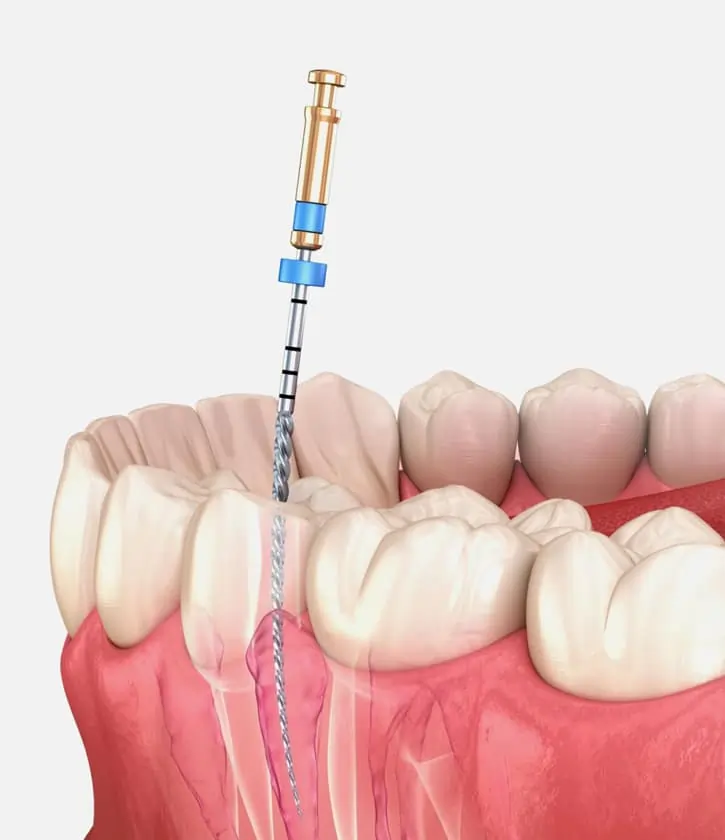

After the procedure, mild sensitivity is normal and usually subsides within a few days. Maintaining good oral hygiene and attending follow-up visits will help ensure long-term success.
A root canal sounds bigger than it is. For most patients the visit feels much like having a large filling. This is what happens at our Mississauga office:
Most root canals take one or two visits of about 60 to 90 minutes. A tooth with a bad infection may get medicine inside it first and be finished at a second visit.
Root canal treatment at a general dental office in Mississauga usually costs about $700 to $1,500. Front teeth have one canal and cost less. Molars have three or four canals, take longer, and sit at the top of that range.
We give you a written estimate before treatment starts, so you know your share of the cost. For a full breakdown, read our root canal cost guide.
Pulling a painful tooth can look like the quicker and cheaper choice. Over time it usually costs more, because the gap needs to be filled:
Sometimes a tooth is too broken or too infected to save. In that case we will explain why and talk you through tooth extraction and your replacement options.
Most root canals are done in our office by our general dentists, including Dr. Sahil Gagnani. We are not a specialist endodontic practice, and we say so plainly.
We refer you to a registered endodontist (a root canal specialist) when a tooth has very curved or blocked canals, when an old root canal needs to be redone, or when surgery at the root tip (an apicoectomy) is needed. We arrange the referral and stay involved in your care afterwards. Our guide on endodontists in Mississauga explains when a specialist is the better choice.
We see patients for root canal treatment from Erin Mills, Churchill Meadows, Streetsville, Meadowvale and Lisgar. Our office is at 3960 Eglinton Avenue West, Unit 12, open Monday to Saturday, 10 am to 6 pm.
Root canal treatment at a general dental office in Mississauga typically costs about $700 to $1,500, depending on the tooth: front teeth cost less and molars cost more because they have more canals. A crown is usually recommended afterwards on back teeth and is quoted separately. We give you a written estimate before treatment starts.
With modern local anaesthetic, a root canal usually feels similar to having a filling. Most of the pain patients worry about comes from the infection itself, and treatment is what relieves it. Some tenderness for a few days afterwards is normal and is usually managed with over-the-counter pain relief.
Common signs are a lingering toothache, pain when biting, sensitivity to hot or cold that stays after the food or drink is gone, a darkening tooth, or a pimple-like bump on the gum near the tooth. Sometimes there are no symptoms at all and the infection is found on an X-ray, so a dental exam is the only way to know for sure.
Most root canals can be completed in our Mississauga office. If a tooth has very curved or calcified canals, needs retreatment of an old root canal, or needs root-end surgery, we refer you to a certified endodontist and coordinate your care.
Many root canals are finished in one or two visits of about 60 to 90 minutes. Teeth with a severe infection may need a second visit so the infection can settle before the canals are sealed.
Usually not. Extraction is cheaper upfront, but a missing tooth lets neighbouring teeth drift and often leads to an implant or bridge later. Saving your natural tooth with a root canal and crown is generally the better long-term option when the tooth can be restored.
Most private dental plans cover a large share of root canal treatment under basic or major services. Eligible patients may also be covered by the Canadian Dental Care Plan (CDCP). We can check your coverage and submit a pre-determination before treatment.
If you are in pain or have swelling, call 905-607-1112. We keep urgent appointments Monday to Saturday, 10 am to 6 pm, and can often start treatment or relieve the pain on the same day.
Root canal treatment has a high success rate, and most treated teeth last for many years, especially when they are protected with a crown and kept clean.
Avoid chewing on the tooth until it is fully restored, take pain relief as directed, and keep brushing and flossing normally. If a crown is recommended, have it placed soon to protect the tooth from breaking.
Usually yes for molars and premolars. These back teeth take most of the chewing force, and a tooth that has had a root canal can crack. Front teeth can often be restored with a filling. We will tell you which applies to your tooth before treatment.
No. Antibiotics can calm swelling for a short time, but they cannot reach the infected pulp inside the tooth. Without a root canal or an extraction, the infection usually comes back and can spread.
Limited-Time Anniversary Offer
Straighter Teeth, Without Braces
Comprehensive clear aligner treatment at Eglinton Oak Dental, Mississauga. Save up to $2,000.
*Limited-time offer for new patients. Candidacy and full details confirmed at your consultation.