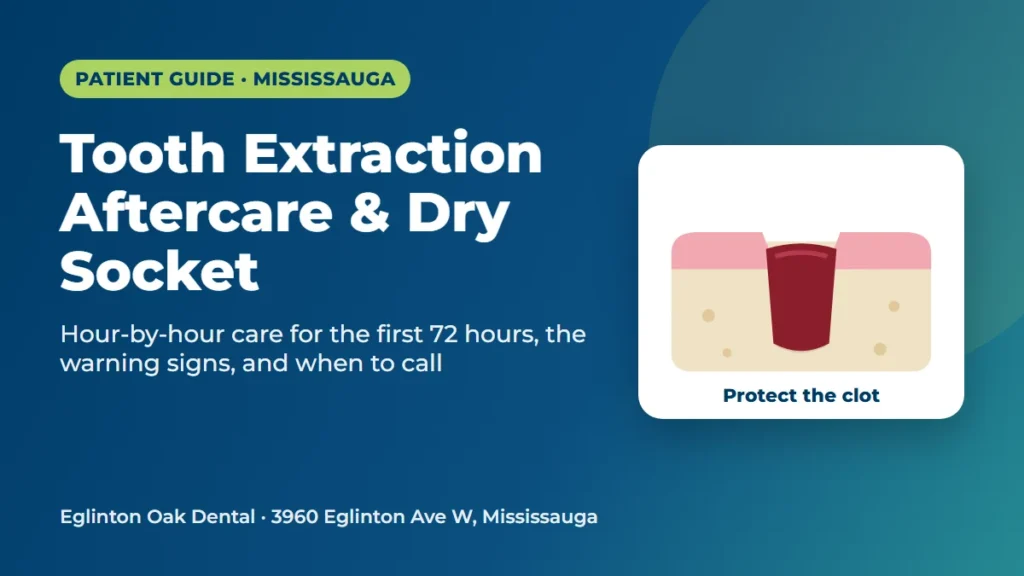
The hour after a tooth comes out matters more than most people think. A blood clot forms in the empty socket, and that small clot is what lets the gum and bone heal. Protect it for the first three days and most extractions heal without trouble. Lose it too early and you can end up with a dry socket, the most common painful complication after an extraction. This guide walks you through tooth extraction aftercare hour by hour, explains how to tell normal soreness from a dry socket, and tells you exactly where to get help in Mississauga, including on a Sunday when our office is closed.
Written by the Eglinton Oak Dental team, 3960 Eglinton Ave W, Unit 12, Mississauga. Last updated October 20, 2026. This is general information, not a diagnosis. Always follow the written instructions your own dentist gives you, because they are based on your tooth and your health history.
Key points (the short answer)
- Protect the clot for 72 hours: no straws, spitting, smoking, vaping or vigorous rinsing.
- Normal healing gets better each day. Soreness and swelling peak on day 2 to 3, then ease.
- A dry socket gets worse, not better. Pain that builds on day 2 to 4 and spreads toward the ear, with a bad taste and an empty-looking socket, is the classic sign.
- A dry socket is treatable. Your dentist rinses the socket and places a soothing dressing. Relief often comes within a day.
- In Mississauga: call us at 905-607-1112 (Mon to Sat, 10 to 6). Outside hours, call Health811 for advice, and go to an emergency department or call 911 for spreading swelling, trouble breathing or swallowing, or bleeding that won’t stop.
On this page
What is a dry socket?
A dry socket, called alveolar osteitis by dentists, happens when the blood clot in the socket is lost, breaks down, or never forms properly. The bone and nerve endings inside the socket are then exposed to air, food and saliva, which is why it hurts so much more than normal healing.
It is not common after a routine extraction. Studies usually put it at roughly 1 to 5 percent of ordinary extractions. The rate is much higher after the removal of impacted lower wisdom teeth, where some studies report rates of 20 to 30 percent or more. Lower back teeth are affected more often than upper ones, because the bone there is denser and has a poorer blood supply.
When does it start? Dry socket pain usually begins one to three days after the extraction. Nearly all cases appear within the first week. If you reach day five or six and your pain is steadily improving, a dry socket becomes very unlikely.
Dry socket symptoms
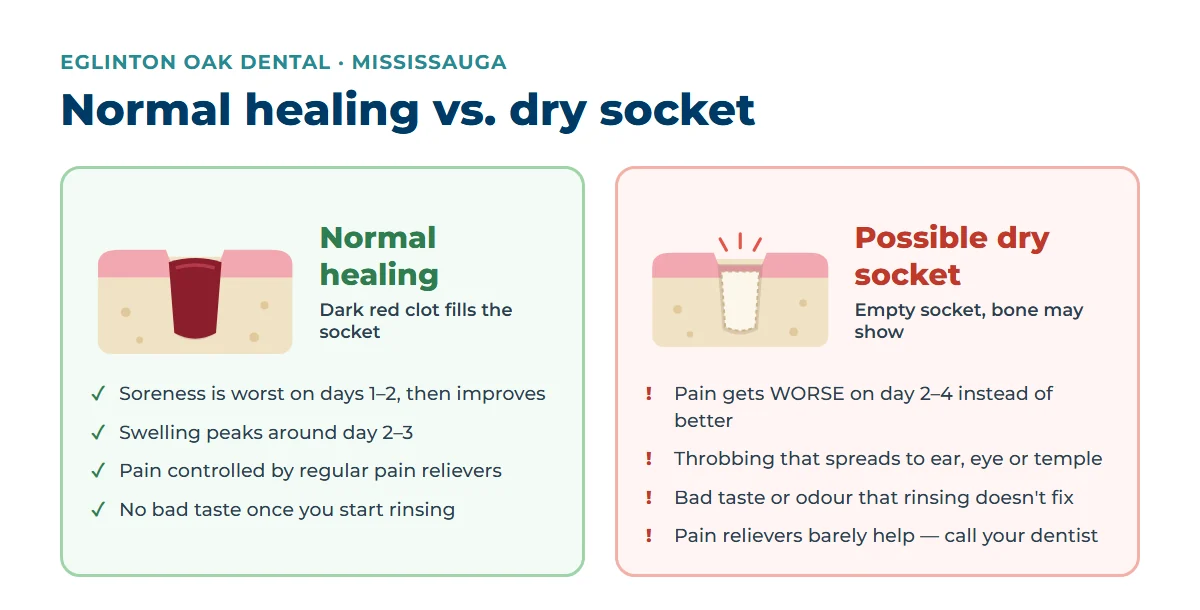
- Pain that gets worse on day 2, 3 or 4 instead of slowly improving
- A deep, throbbing ache that spreads to the ear, eye, temple or neck on the same side
- A bad taste in the mouth or bad breath that rinsing doesn’t fix
- Pain that over-the-counter pain relievers barely touch
- Sometimes a slight fever or tender glands under the jaw
What does a dry socket look like?
A healing socket looks dark red, because it is filled with a clot. After a few days that clot can be covered by a soft, creamy white or yellowish film. That film is normal healing tissue, not pus, and it is one of the most common things patients worry about. A dry socket looks different: the hole looks empty, or you may see whitish-grey bone at the bottom, and food can collect in it. It is hard to see your own lower back teeth clearly, so judge mostly by the pain pattern, not the mirror.
Tooth extraction aftercare: the first 72 hours
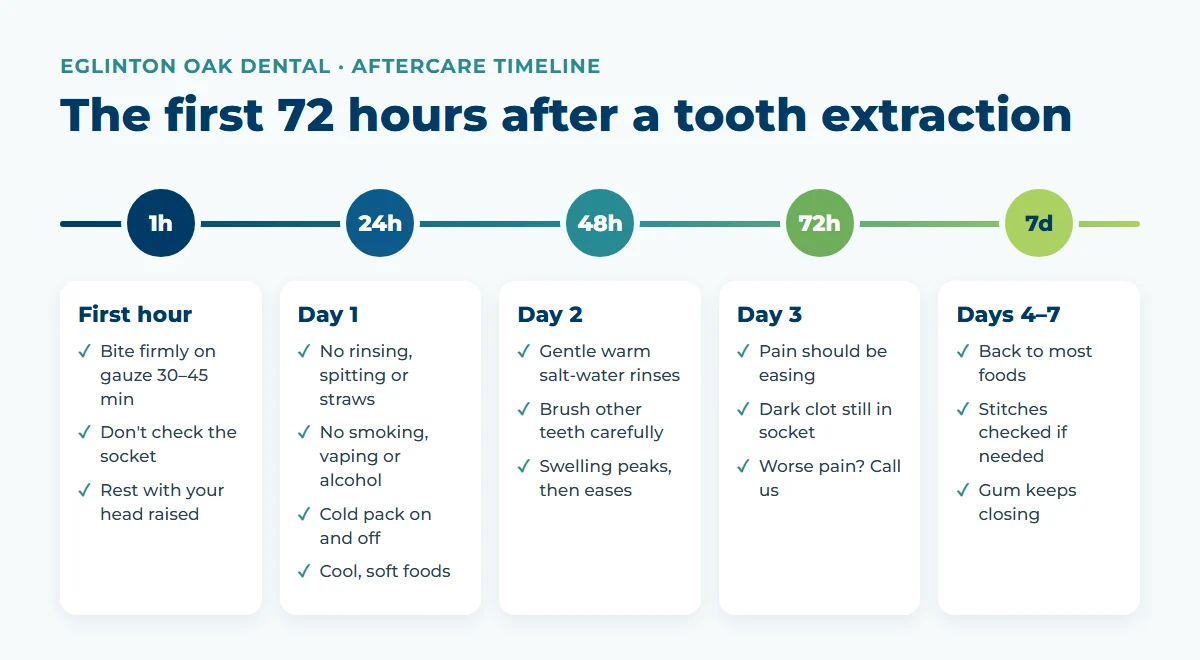
The goal of the first three days is simple: let the clot form, and don’t disturb it. Everything below follows from that.
Before you leave the chair: a quick checklist
- Do I have stitches? Are they dissolvable, or do I need to come back to have them removed?
- Which pain relievers can I safely take with my other medications?
- Do I have a prescription, and when should I start it?
- When can I restart any medication I was asked to adjust? (Never stop a blood thinner without your doctor’s advice.)
- Who do I call if something feels wrong, and what are the office hours?
Our team gives every extraction patient written instructions and a number to call. Keep them on your fridge or take a photo on your phone.
The first hour: let the clot form
- Bite firmly and steadily on the gauze for 30 to 45 minutes. Don’t chew on it or keep checking it.
- If the site is still oozing when you remove it, place a fresh, folded, slightly damp gauze directly over the socket and bite for another 30 minutes. A damp black tea bag works well too, because tea contains tannins that help blood clot.
- Some pink-tinged saliva for the rest of the day is normal. Steady, bright red bleeding that fills your mouth is not.
- Rest with your head raised. Don’t drive if you had sedation.
The first 24 hours: protect the clot
- No rinsing, no spitting, no straws. All three create pressure or suction that can pull the clot out. Let liquids fall out of your mouth into the sink instead of spitting.
- No smoking, vaping or cannabis. See the prevention section below for how long to wait.
- No alcohol, and avoid very hot drinks. Let tea or coffee cool to lukewarm.
- Cold pack: hold an ice pack wrapped in a cloth on your cheek for about 15 to 20 minutes on, then 15 to 20 minutes off, for the first day.
- Brush your other teeth gently at bedtime, but stay away from the extraction site.
- Sleep with an extra pillow so your head is higher than your heart. Put an old towel on the pillow in case of a little overnight oozing.
- Skip the gym, heavy lifting and bending over for at least 48 hours. A raised heart rate can restart bleeding.
Day 2 (24 to 48 hours): gentle cleaning begins
- Start warm salt-water rinses: about half a teaspoon of salt in a cup (250 mL) of warm water. Tilt your head side to side to let it wash over the area, then let it fall out. Do this after meals and at bedtime.
- Brush the teeth next to the socket carefully with a soft brush.
- Swelling and jaw stiffness usually peak around now. That is expected. From this point a warm, moist cloth can feel better than ice.
- Keep taking your pain relievers on schedule if your dentist advised it, rather than waiting until the pain builds.
Day 3 (48 to 72 hours): what you should notice
- Pain should be the same or a bit better than yesterday, not worse.
- Swelling should start to go down. Some yellow or greenish bruising on the cheek can appear, especially after a surgical extraction, and fades over a week.
- The socket should still contain a dark clot, possibly with a white film over it.
- If the pain is clearly worse than on day 1 or 2, call us. That pattern is the main warning sign of a dry socket.
Days 4 to 7: getting back to normal
- Most people are eating a fairly normal diet again, chewing on the other side.
- Non-dissolving stitches are usually removed at about one week. Dissolvable stitches loosen and fall out on their own within one to two weeks. A loose stitch is not an emergency.
- If you were given a plastic syringe to rinse the socket (common after lower wisdom teeth), start using it when your dentist told you to, usually from about day 3 to 5.
Managing pain and swelling
Some pain after an extraction is normal, and how much depends on the tooth. A simple extraction of a front tooth may only need pain relievers for a day. A surgical extraction of a lower molar can be sore for several days.
- Take pain relievers before the freezing wears off, and then on a regular schedule for the first day or two, as directed. It is easier to stay ahead of the pain than to catch up.
- Ibuprofen (an anti-inflammatory) is often the first choice for dental pain because it also reduces swelling. Many dentists recommend combining or alternating it with acetaminophen. Ask your dentist or pharmacist what is safe for you. This is especially important if you take blood thinners, have kidney or stomach problems, have asthma, or are pregnant.
- Avoid ASA (Aspirin) for pain unless your doctor prescribed it for your heart, because it can increase bleeding. Don’t stop a prescribed ASA on your own.
- Never take more than the daily limit on the package, and remember that some cold and flu products also contain acetaminophen.
- If you were prescribed antibiotics, finish the course exactly as directed. Antibiotics are not routinely needed after an extraction. They are used when there is a spreading infection or a medical reason.
What’s normal: soreness that peaks on day 1 to 3 and then eases, swelling that peaks around day 2 to 3, mild jaw stiffness, and a little bruising. What’s not: pain that is getting worse after day 3, swelling that keeps increasing after day 3, fever, pus, or numbness that lasts long after the freezing should have worn off.
What to eat after a tooth extraction
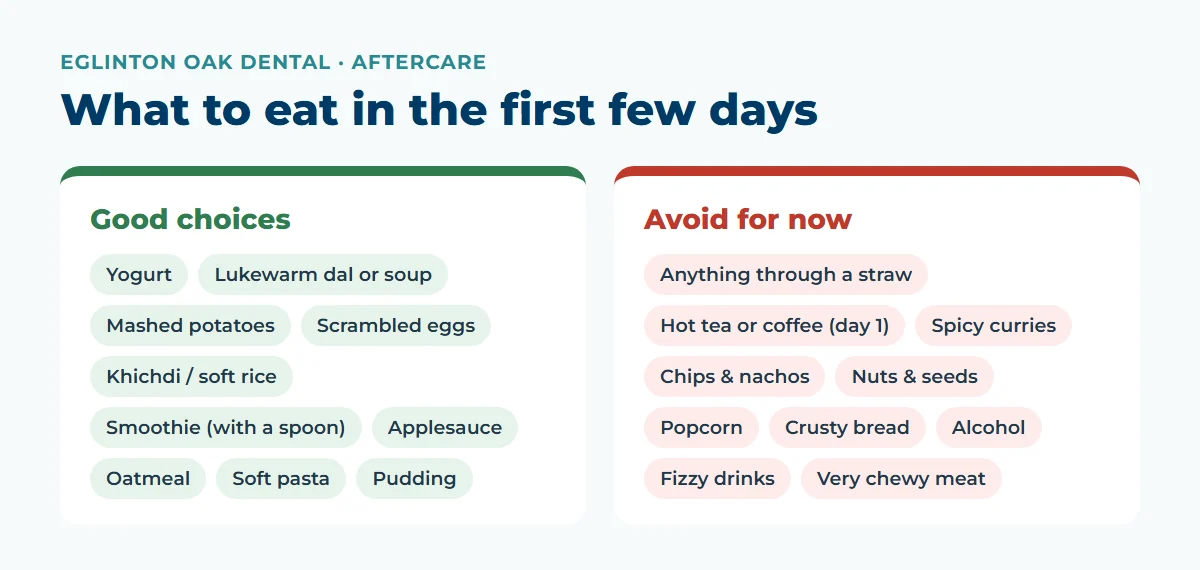
For the first two or three days, choose foods that are soft, cool or lukewarm, and easy to eat without much chewing. Chew on the opposite side. Don’t skip meals: eating well and drinking enough water help you heal.
| When | Good choices | Avoid |
|---|---|---|
| Day 1 | Yogurt, applesauce, pudding, cool smoothies eaten with a spoon, lukewarm soup or dal, mashed potatoes | Straws, hot drinks, alcohol, anything crunchy or spicy |
| Days 2 to 3 | Scrambled eggs, oatmeal, soft khichdi or congee, soft pasta, flaked fish, well-cooked vegetables | Chips, nuts, seeds, popcorn, crusty bread, spicy curries |
| Days 4 to 7 | Most of your usual foods, cut small and chewed on the other side | Very hard, sticky or chewy foods near the socket; small seeds or rice grains packed into the socket |
A tip for families in our area: many of the soft, mild foods already in a South Asian, Middle Eastern or Filipino kitchen, such as dal, khichdi, yogurt rice and congee, are ideal after an extraction. Just let them cool to lukewarm and go easy on the chili for a few days.
How to prevent a dry socket
You can’t control every risk factor, but the ones you can control matter most in the first 72 hours.
- Don’t smoke or vape. Smoking is the biggest avoidable risk. The suction of inhaling can dislodge the clot, and nicotine reduces blood flow to the healing socket. Avoid smoking, vaping and cannabis for at least 72 hours, and ideally for a full week or until the socket has closed. Nicotine patches are a better option than smoking if you can’t stop completely; ask your pharmacist.
- Skip straws for at least the first 3 days. After a surgical or wisdom tooth extraction, avoiding them for a full week is the safest choice.
- Don’t spit or rinse hard for the first 24 hours, and keep rinses gentle after that.
- Keep your mouth clean from day 2 with gentle salt-water rinses and careful brushing. Bacteria break down clots.
- Don’t poke the socket with your tongue, fingers or a toothpick.
- Tell us your health history. Some people are at higher risk, and your dentist may take extra steps for them.
Who is at higher risk?
| Risk factor | Why it matters |
|---|---|
| Smoking or vaping | Suction plus reduced blood flow. The single biggest avoidable risk. |
| Lower wisdom teeth and surgical extractions | Denser bone with less blood supply, and more trauma to the area. |
| Oral contraceptives (birth control pills) | Estrogen may speed up the breakdown of the clot. Mention it when booking. |
| A previous dry socket | People who’ve had one are more likely to have another. |
| Existing infection or gum disease | More bacteria around the socket. |
| Not following aftercare | Straws, spitting, hard rinsing or poor cleaning in the first days. |
Special situations
- Upper back teeth and your sinus. The roots of upper molars and premolars can sit very close to the sinus. For about a week, avoid blowing your nose hard, sneeze with your mouth open, and avoid flying or scuba diving if your dentist mentioned a sinus opening. Tell us if liquid comes out of your nose when you drink.
- Blood thinners. Most people should not stop their blood thinner for a routine extraction. Bleeding is usually controlled locally. Never stop or skip a dose without speaking to the doctor who prescribed it. Tell us about every medication before the appointment.
- Diabetes, or a weakened immune system. Healing can be slower and infection more likely. Keep your blood sugar well controlled and tell us about your condition.
- If you are fasting. If an extraction falls during a fast, such as Ramadan, tell us when you book. We can plan the timing so you can take pain relievers and stay hydrated when you need to.
Dry socket vs. normal healing
| Normal healing | Possible dry socket | |
|---|---|---|
| Pain pattern | Worst on day 1 to 2, then steadily improves | Improves, then gets worse on day 2 to 4 |
| Where it hurts | Around the site | Throbbing that spreads to the ear, eye, temple or neck |
| What the socket looks like | Dark clot, later a white or yellowish film | Empty-looking, or greyish-white bone visible |
| Taste and smell | Little or none once you start rinsing | Bad taste or odour that won’t go away |
| Pain relievers | Keep you comfortable | Barely help |
| What to do | Keep following your aftercare | Call your dentist the same day |
Dry socket treatment: what happens at the dentist
A dry socket won’t damage your health in the long run, but it won’t feel better quickly on its own either. Treatment is quick and usually brings real relief:
- Freezing if needed. The area can be numbed so the visit is comfortable.
- Gentle cleaning. The socket is rinsed, often with sterile saline, to remove trapped food and debris.
- A medicated dressing. A soothing paste or dressing is placed in the socket. Many patients feel noticeably better within hours to a day.
- Follow-up. You may come back every day or two for the dressing to be changed until the pain settles.
- Home care. Regular pain relievers as advised, gentle salt-water rinses, and no smoking. Antibiotics are only prescribed if there are signs of a spreading infection or a medical reason.
With treatment, the pain usually settles within a few days and the socket heals over roughly one to two weeks.
What does dry socket treatment cost? It is a short visit. If your extraction was done at our office, call us first and we’ll see you to check the site. For new patients, we’ll tell you the fee before we start. Most private dental plans cover follow-up visits after an extraction, and we can check your coverage, including the Canadian Dental Care Plan (CDCP).
Can you treat a dry socket at home? You can ease the symptoms until you’re seen: take your pain relievers as directed, rinse gently with warm salt water, and avoid smoking. But home remedies such as clove oil on cotton, or packing the socket yourself, can irritate the area or leave material behind. Let your dentist place the dressing.
Getting help after an extraction in Mississauga
Eglinton Oak Dental is at 3960 Eglinton Ave W, Unit 12, serving patients from Churchill Meadows, Erin Mills, Central Erin Mills, Lisgar, Streetsville and Meadowvale. We’re open Monday to Saturday, 10 a.m. to 6 p.m., and closed Sundays. We are not a 24-hour clinic, so here is what to do at any hour:
| Situation | What to do |
|---|---|
| Worsening pain, a bad taste, a possible dry socket, a loose stitch, a question | Call us at 905-607-1112 during office hours. We’ll do our best to see you the same day. |
| The same problems after hours or on a Sunday | Keep taking pain relievers as directed and keep the area clean. Call Health811 (dial 811) for free advice from a registered nurse, then call us when we open. |
| Trouble breathing or swallowing, swelling spreading to the eye, neck or under the tongue, high fever with a swollen face, bleeding that won’t stop after an hour of firm pressure, or an allergic reaction | This is a medical emergency. Call 911 or go to the nearest hospital emergency department. For patients near our office, that is usually the Credit Valley Hospital emergency department (Trillium Health Partners), 2200 Eglinton Ave W at Erin Mills Parkway. |
A practical tip: dry socket pain usually starts on day 2 to 4. If you can choose, book a planned extraction early in the week, Monday to Wednesday, so those days fall when our office is open. Find us on our booking page.
Tooth extraction healing stages after the first week
| Time after extraction | What’s happening |
|---|---|
| Days 1 to 3 | The clot forms and stabilizes. Soreness and swelling peak, then ease. |
| Days 4 to 7 | New gum tissue grows in from the edges. A white or yellowish film over the socket is normal. |
| Weeks 1 to 3 | The gum closes over the socket. A small dip remains. Food may still catch there, so keep rinsing after meals. |
| Months 1 to 4 and beyond | Bone fills in and reshapes underneath. The ridge slowly shrinks, which matters if you plan to replace the tooth. |
Planning to replace the tooth
If the extracted tooth was a front tooth or an important chewing tooth, think about replacement early. The bone starts to reshape in the first few months, and neighbouring teeth can drift into the gap. Your options are a dental implant, a dental bridge or a partial denture. If an implant is likely, ask about socket preservation at the time of extraction. Our tooth extraction guide covers when an extraction is needed, simple vs. surgical extraction, typical Mississauga costs and these replacement options in detail. For wisdom teeth specifically, see our wisdom tooth removal cost and recovery guide.
Frequently asked questions
How do I know if I have a dry socket or normal pain?
Normal pain is worst on the first day or two and then improves a little each day. Dry socket pain gets worse instead, usually starting on day 2 to 4. It is a deep, throbbing pain that often spreads to the ear, eye or temple on the same side, comes with a bad taste or smell, and barely responds to pain relievers. If your pain is building after day 2, call your dentist.
How long after a tooth extraction can you get a dry socket?
Dry socket usually appears one to three days after an extraction, and nearly all cases appear within the first week. If you are past day five or six and your pain is steadily improving, a dry socket is very unlikely.
How long should I avoid straws after a tooth extraction?
Avoid straws for at least the first 3 days, when the clot is most fragile. After a surgical or wisdom tooth extraction, avoiding straws for a full week is the safest choice.
When can I smoke or vape after a tooth extraction?
Wait at least 72 hours, and ideally a full week or until the socket has closed. Smoking and vaping are the biggest avoidable causes of dry socket because of the suction and reduced blood flow. Cannabis smoke has the same effect.
What should I eat after a tooth extraction?
For the first two or three days eat soft, cool or lukewarm foods such as yogurt, applesauce, mashed potatoes, scrambled eggs, oatmeal, lukewarm soup or dal, and soft rice. Chew on the other side. Avoid straws, hot drinks on day one, alcohol, spicy food, and anything crunchy, hard or full of small seeds.
When can I rinse with salt water after an extraction?
Start 24 hours after the extraction. Use about half a teaspoon of salt in a cup of warm water, tilt your head gently to move it around, and let it fall out of your mouth rather than spitting. Rinse after meals and at bedtime for about a week.
Is the white stuff in my tooth socket normal?
Usually, yes. A soft, creamy white or yellowish film over the socket a few days after an extraction is normal healing tissue, not pus. It is a concern only if it comes with increasing pain, swelling, fever, or a foul taste.
How is a dry socket treated?
Your dentist gently rinses the socket to remove debris and places a soothing medicated dressing. Many people feel much better within hours to a day. The dressing may be changed every day or two until the pain settles, and the socket usually heals over one to two weeks. Antibiotics are only needed if there are signs of spreading infection.
Where can I get help for a dry socket in Mississauga on a Sunday?
Eglinton Oak Dental is open Monday to Saturday, 10 a.m. to 6 p.m. On a Sunday or after hours, keep taking pain relievers as directed and call Health811 (dial 811) for free nursing advice, then call 905-607-1112 when we open. For trouble breathing or swallowing, rapidly spreading swelling, or bleeding that will not stop, call 911 or go to the nearest emergency department, such as Credit Valley Hospital at 2200 Eglinton Ave W.
How long does it take for a tooth extraction to heal?
Most soreness settles within 3 to 7 days. The gum closes over the socket in about one to three weeks, and the bone underneath keeps filling in and reshaping for several months. Wisdom teeth and surgical extractions take longer than simple ones.
Summary
Good tooth extraction aftercare comes down to protecting the blood clot for the first three days: bite on gauze, rest, no straws, no spitting, no smoking or vaping, and gentle salt-water rinses from day 2. Normal healing gets a little better every day. If your pain gets worse on day 2 to 4, spreads toward your ear, and comes with a bad taste, you may have a dry socket. It’s very treatable, so call your dentist rather than waiting it out.
Worried about a socket that isn’t healing?
Call 905-607-1112 and we’ll fit you in to check it, or book an appointment online. Need a tooth looked at before it gets to this point? See our emergency dentistry page. Eglinton Oak Dental, 3960 Eglinton Ave W, Unit 12, Mississauga, ON L5M 2R9. Open Monday to Saturday, 10 a.m. to 6 p.m.
Sources & Further Reading
- Canadian Dental Association: Oral surgery and care after minor oral surgery
- MedlinePlus (U.S. National Library of Medicine): Dry socket
- Scottish Dental Clinical Effectiveness Programme: Alveolar osteitis (dry socket) and Dental patients taking anticoagulants or antiplatelet drugs
- Government of Ontario: Health811 (free 24/7 health advice by phone at 811)
- Government of Canada: What services are covered in the Canadian Dental Care Plan