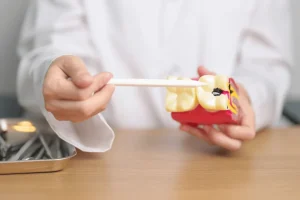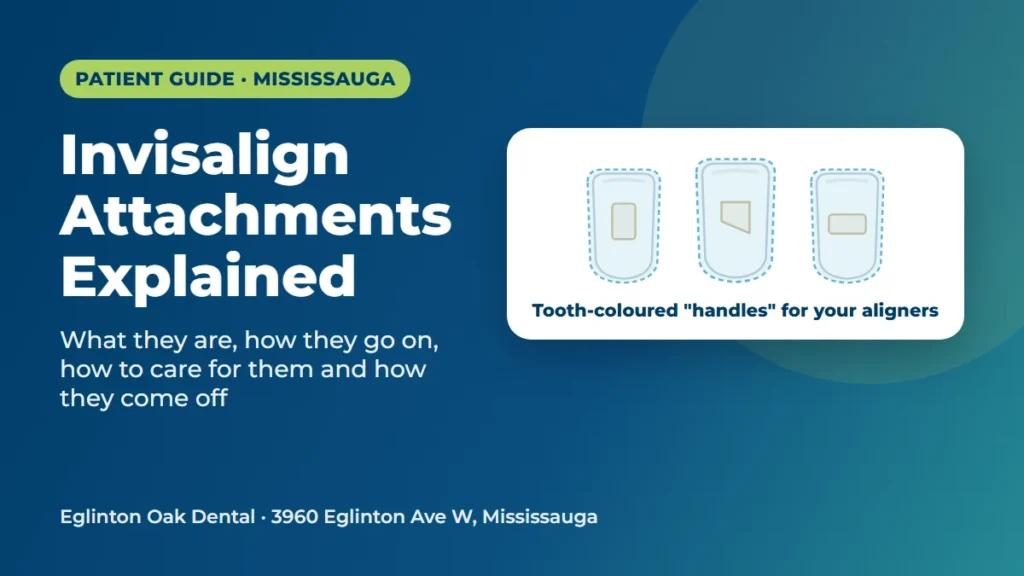
Invisalign attachments are small, tooth-coloured bumps of composite resin that your dentist bonds to selected teeth during clear aligner treatment. Each aligner has a matching pocket that snaps over them, so the tray can grip the tooth and push it in directions smooth plastic cannot manage alone, such as rotating a rounded tooth or moving a tooth up or down. They go on in one short visit without needles or drilling, they stay on for most of your treatment, and they are polished off at the end. This guide explains what to expect at each step, written for patients of our Mississauga office and anyone in Churchill Meadows, Erin Mills, Streetsville, Meadowvale or Oakville who is weighing up aligner treatment.
Written by the Eglinton Oak Dental team, 3960 Eglinton Ave W, Unit 12, Mississauga. Last updated November 3, 2026. This article is general information, not a diagnosis or a treatment plan. Whether you need attachments, and where, can only be decided after an examination and a 3D scan of your own teeth.
Key points (the short answer)
- What they are: small shapes of tooth-coloured filling material bonded to the front or side of some teeth. They are not braces and there are no wires.
- Why they are used: they act like handles, so the aligner can rotate, tip, raise or lower a tooth more predictably.
- Not everyone needs them. Some simple cases need none; complex cases may need a dozen or more. Your 3D treatment plan shows exactly which teeth get one.
- Placing them takes one visit, usually under an hour, with no needles and no drilling.
- Removing them at the end is quick: your dentist polishes them away and the enamel underneath is left smooth.
- If one comes off, keep wearing your aligners and call us at 905-607-1112 (Monday to Saturday, 10 to 6) so it can be re-bonded with the template.
On this page
- What are Invisalign attachments?
- Why your plan may need them
- How many you need, and on which teeth
- Attachments vs. buttons and elastics
- The attachment appointment, step by step
- How they feel and how they look
- Daily care, food and drinks
- How attachments are removed
- Are attachments safe for your enamel?
- Teeth whitening and attachments
- Teens, adults and dental work
- Cost and insurance
- Attachments at Eglinton Oak Dental
- Frequently asked questions
What are Invisalign attachments?
An attachment is a tiny raised shape, usually two to four millimetres across, made from the same kind of tooth-coloured composite resin used for white fillings and dental bonding. It is bonded to the enamel surface of a tooth and shaded to blend in. Invisalign’s planning software decides the shape, size, angle and position of every attachment so that it lines up with the force the aligner needs to apply.
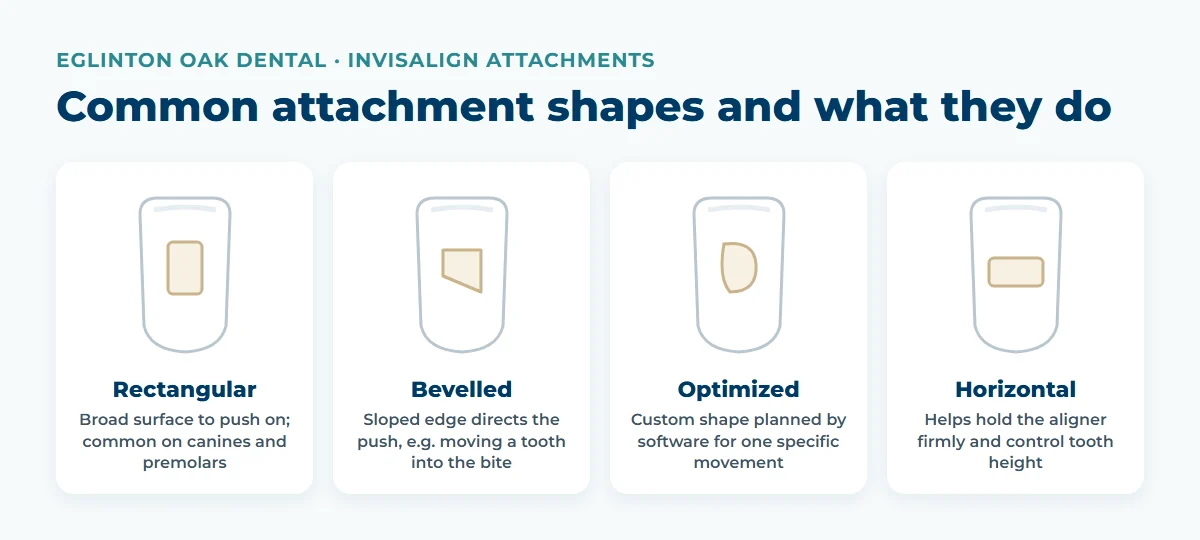
You will hear a few different names for the shapes:
- Rectangular attachments (vertical or horizontal) give a broad, flat surface to push against. They are common on canines and premolars.
- Bevelled attachments have one sloped edge, which directs the push in one direction, for example to help a tooth move down into the bite.
- “Optimized” attachments are custom shapes the software designs for a particular movement on a particular tooth, such as a rotation or root control.
Your aligners are then made with small hollow bubbles in exactly those spots. When you seat a tray, each bubble clicks over its attachment, and that tight fit is what lets the tray steer the tooth.
Why your Invisalign plan may need attachments
Aligners move teeth by pressing on them. On a flat front tooth that is easy: the plastic pushes on a broad surface and the tooth tips the way it should. Many teeth are not that cooperative. Premolars and canines are rounded, and a smooth tray tends to slip over them instead of turning them. Some movements also need the tray to pull rather than push, which plastic cannot do on a smooth surface.
Attachments solve this by giving the aligner an edge to catch. They are typically planned for:
- Rotations, especially of round teeth such as canines and lower premolars.
- Extrusion, which means bringing a tooth down (or up) into the bite, a common need when correcting an open bite.
- Root movement, so the whole tooth moves upright instead of just tipping at the crown.
- Closing gaps, including spaces left after an extraction, where teeth must slide without leaning.
- Anchorage and retention, where a few attachments simply hold the tray firmly so the force goes to the teeth that are meant to move.
Without them, the most common problem is “tracking”: the teeth stop following the plan, the trays no longer sit fully on the teeth, and extra refinement aligners are needed. Attachments are one of the main tools used to keep treatment on schedule.
Can you have Invisalign without attachments?
Sometimes. A small amount of crowding on the front teeth, a minor relapse after old braces, or closing a small gap can occasionally be planned with few or no attachments. For most full cases, though, removing them from the plan would make some movements unreliable and could lengthen treatment. If the look of attachments worries you, tell us at your consultation. We can review the 3D plan with you and show which teeth need them and why, and sometimes the number or position can be adjusted. What we will not do is promise an attachment-free plan before we have seen your scan.
How many attachments will you need, and on which teeth?
There is no standard number. It depends on how far your teeth have to travel and in which directions. As a rough guide:
| Type of case | Typical attachments | Usual locations |
|---|---|---|
| Minor crowding or a small gap on the front teeth | None to a few | Canines, sometimes a front tooth |
| Moderate crowding or rotations | Around 6 to 12 | Canines and premolars, upper and lower |
| Full case with bite correction | Often 12 to 20 or more | Most premolars and canines, some molars |
Attachments are placed mostly on the cheek-facing side of the teeth. Occasionally one goes on the tongue side or on a molar. Before treatment starts you will see your plan on screen: the attachments appear as small coloured shapes on the 3D model, and you can watch how each tooth is expected to move from the first tray to the last. Individual results vary, and the plan is a guide that may need refinements along the way.
Attachments vs. buttons and elastics
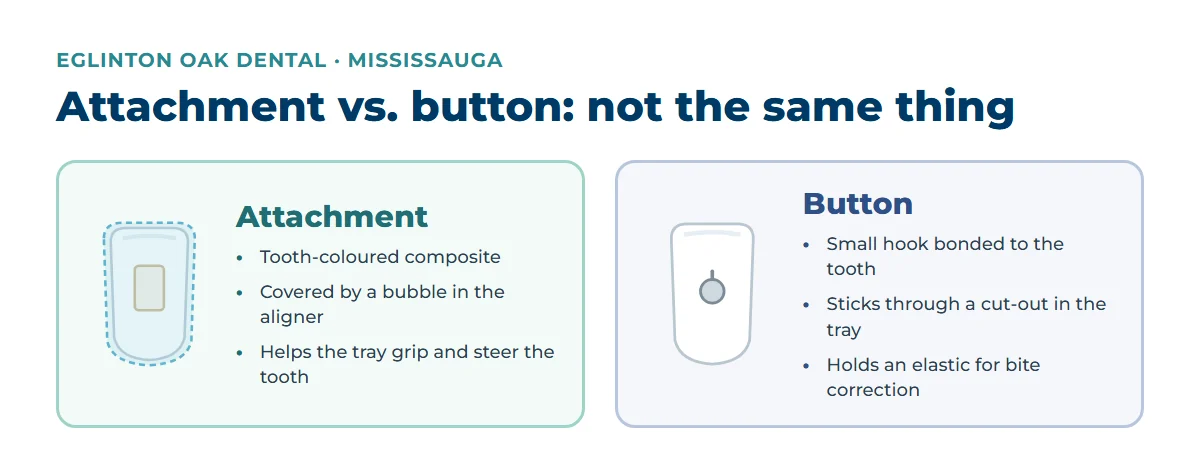
Patients sometimes hear the word “button” and assume it means the same thing. It does not.
| Attachment | Button | |
|---|---|---|
| What it is | Tooth-coloured composite shape bonded under the aligner | Small hook, often clear or metal, bonded to the tooth |
| Job | Helps the aligner grip and steer the tooth | Holds a small rubber band (elastic) |
| Aligner design | Tray has a matching bubble that covers it | Tray has a cut-out so the button sticks through |
| Used for | Rotations, tooth height, root control, retention | Overbite, underbite and other bite corrections between the jaws |
| How common | Used in most full cases | Only when elastics are part of the plan |
Many bite corrections use elastics hooked either onto buttons or onto small “precision cuts” in the aligner itself. If your plan includes elastics, we will show you how to put them on and how many hours a day to wear them. Severe bite problems can be better suited to fixed braces or to a specialist; see our page on braces and orthodontics in Mississauga.
The attachment appointment, step by step
Attachments are usually placed at the visit where you receive your first aligners, or a tray or two later if your plan calls for it. The process is similar to a small cosmetic bonding and does not need freezing.
- Cleaning and polish. The teeth that will get attachments are polished so the bond holds well.
- Isolation. Cheek retractors and cotton keep the teeth dry, because moisture weakens the bond.
- Conditioning the enamel. A mild gel is painted on small spots for a few seconds, rinsed off, and a bonding liquid is applied. This roughens the surface at a microscopic level only.
- The template tray. We fill a thin plastic template, shaped like an aligner, with tooth-coloured composite in each attachment pocket, then seat it over your teeth.
- Curing. A blue light hardens the material through the template in a few seconds per tooth.
- Clean-up and fit check. The template comes off, any excess is smoothed, your bite is checked, and your first aligner is tried in so you can practise putting it in and taking it out.
Most appointments take 30 to 60 minutes, depending on how many attachments you need. You can eat normally afterwards, although the first few trays will feel snug.
What do Invisalign attachments feel like?
Your tongue and lips will notice them straight away, because anything new on a tooth feels larger than it is. For the first two to five days they can feel rough against the inside of the lip, and the first aligner may feel tight over them. Both settle quickly. A little orthodontic wax on a sharp edge helps, and if an attachment still rubs after a week, we can smooth it at a short visit.
The aligners themselves take a slightly different technique once attachments are on. Instead of pulling a tray off at the front, loosen it from the back molars on one side, then the other, and work forward with your fingertips. Never use your teeth or a sharp object to pry trays off.
Are Invisalign attachments noticeable?
From a normal conversational distance, most people will not spot them, because they are matched to your tooth shade and sit under clear plastic. They are easier to see up close, in bright light, or on teeth near the front of your smile. They can also become more visible if they pick up stains, which is the main reason the care tips below matter.
Living with attachments: daily care, food and drinks
Attachments create small ledges where plaque likes to collect. Good habits keep them clean and keep the enamel around them healthy:
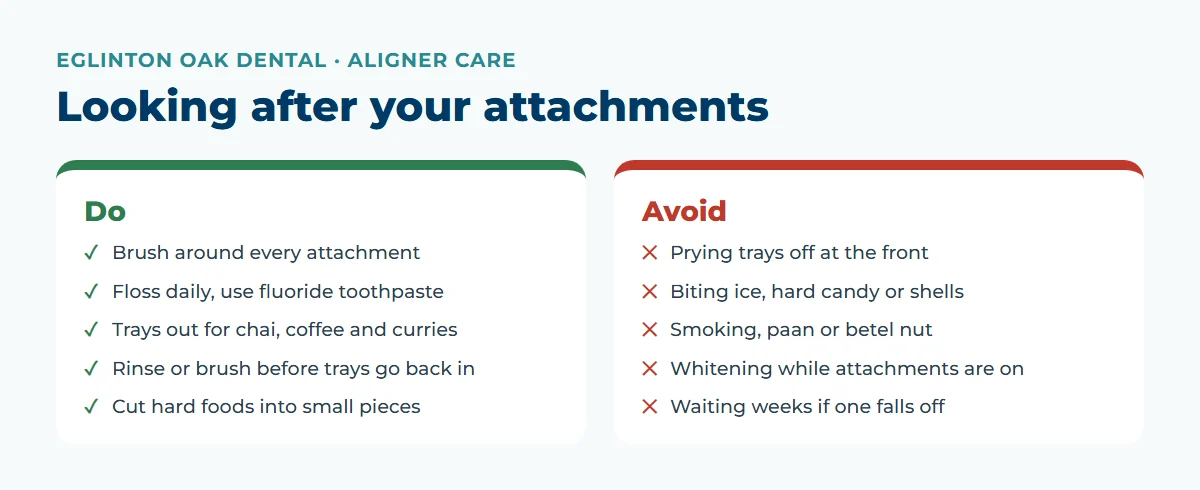
- Brush around each attachment with a soft brush, angling the bristles above and below it. A small interdental or single-tuft brush is handy for the edges.
- Floss every day. Attachments do not block floss, but aligners keep saliva away from the teeth for most of the day, so cleaning between them matters more than usual.
- Use a fluoride toothpaste and do not rinse it away straight after brushing at night.
- Take the aligners out to eat and to drink anything except plain water. Wear them 20 to 22 hours a day as instructed.
- Brush or at least rinse well before the trays go back in, so food and sugar are not trapped against the attachments.
- Keep your regular cleanings. A professional teeth cleaning removes build-up around the attachments that brushing misses.
Stains to watch for. Composite is slightly more porous than enamel. Chai, coffee, black tea, red wine, cola, and curries made with turmeric (haldi) can tint attachments yellow or brown over months. You do not have to give these up. Just enjoy them with the trays out, rinse with water afterwards, and brush before you put the aligners back. Smoking and paan or betel nut stain attachments quickly and are best avoided.
Hard and sticky foods. Because your aligners are out when you eat, attachments do take some chewing force. Biting straight into very hard foods, such as ice, hard candy, nuts in their shells, or corn on the cob, can chip or knock one off. Cut hard foods into smaller pieces and chew with your back teeth.
During Ramadan or other fasts. Many of our patients fast for part of the year. You can keep wearing your aligners through the fasting hours, which makes reaching 20 to 22 hours easier. Remove them for suhoor and iftar, clean your teeth and trays, and put them straight back in. If you need help fitting meals around your wear time, ask us for a plan.
What if an Invisalign attachment falls off?
It happens now and then, usually from biting into something hard. It is not an emergency and it does not hurt, but it should not be left for weeks, because the aligner may stop gripping that tooth and the tooth can fall behind the plan.
- Keep wearing your current aligner unless it no longer fits. Do not skip ahead to the next tray.
- Keep the attachment if you find it, although it is not reused. A new one is made with the template.
- Call us at 905-607-1112. We are open Monday to Saturday, 10 am to 6 pm, and a re-bond is a short appointment.
- Bring your aligners and the attachment template if you were given one.
If several attachments come off, or the trays stop sitting fully on your teeth, mention it when you call so we can check whether your plan needs adjusting.
How are Invisalign attachments removed?
When the last aligner is done and your teeth are where they should be, the attachments come off at a single visit. There is no needle and usually no discomfort beyond a little vibration.
- Your dentist uses a fine polishing bur to remove the composite layer by layer, stopping at the natural enamel.
- The surface is polished smooth, and you can feel the difference with your tongue right away.
- Your teeth are scanned or checked for your retainer. Retainers are made to fit the teeth without attachments, so the order matters.
Removal typically takes a few minutes per tooth. Wearing your retainer exactly as instructed afterwards is what keeps your teeth from drifting back. Occasionally a few attachments are kept on for a short time to help a retainer or a final refinement grip; your dentist will explain if that applies to you.
Are Invisalign attachments safe for your enamel?
When they are placed and removed carefully, attachments are considered safe for healthy enamel. The conditioning gel only affects a very thin surface layer in small spots, and removal is done slowly with polishing instruments designed to stop at the enamel.
The bigger risk comes from plaque, not from the attachment itself. If food and plaque sit around attachments under a tray for hours, the enamel next to them can lose minerals and develop chalky white marks or early cavities. That is why the daily care steps above, fluoride toothpaste and regular hygiene visits matter throughout treatment. If you are prone to cavities, ask us about extra fluoride protection.
Can you whiten your teeth with Invisalign attachments on?
Whitening gel lightens natural enamel but does not change the colour of composite. If you whiten while attachments are on, the enamel underneath each attachment stays its original shade, and you may see small darker patches once they are removed. For that reason, we usually suggest waiting until the attachments come off, then whitening for an even result. Our guide to teeth whitening in Mississauga explains the options. If you plan to whiten, tell us early, because existing white fillings or bonding may also need to be matched afterwards.
Attachments for teens, adults and teeth with dental work
Teens. Attachments work the same way for teenagers. The main difference is supervision: teens are more likely to bite into hard snacks or forget to brush before putting trays back in. Invisalign Teen aligners include wear indicators, and attachment and check-up visits can be booked on Saturdays so students at local Peel schools do not miss class.
Adults. Many adults choose aligners after crowding returns years after childhood braces. Adults are more likely to have crowns, veneers, bridges or large fillings, which affects attachments.
Crowns, veneers and fillings. Attachments bond most reliably to natural enamel. They can be placed on porcelain or older composite using a different preparation, but the bond is less predictable and removal must be done with extra care. Your plan may move an attachment to a neighbouring tooth instead. Make sure we know about all dental work, and see our Invisalign clear aligners guide for who is usually a good candidate.
Do attachments change the cost of Invisalign?
In most aligner plans, attachments are part of the overall treatment, not a separate line on the bill. The same is usually true for replacing an occasional attachment that comes off, although this varies by plan. What drives the price is the complexity of the case and the length of treatment. Your written quote after the consultation will show what is included. For fee ranges, insurance and payment plans, read our guides on how much Invisalign costs in Mississauga and whether Invisalign is covered by insurance in Canada. Comparing options? See Invisalign vs. braces in Mississauga and our clear aligner comparison guide.
Invisalign attachments at Eglinton Oak Dental, Mississauga
Eglinton Oak Dental is a general and family dental practice at 3960 Eglinton Avenue West, Unit 12, Mississauga, ON L5M 2R9. Clear aligner treatment, including attachments, retainers and re-bonds, is provided in-house by our general dentists, led by Dr. Sahil Gagnani, DMD. We are not a specialist orthodontic practice. If your assessment shows a complex bite or jaw problem that would be treated more predictably by an orthodontist, or with fixed braces, we will tell you plainly and coordinate the referral.
What to expect with us:
- An assessment and a 3D digital scan, then a walk-through of your plan on screen, including where each attachment goes and why.
- Attachment placement, removal and any re-bonds done at our office, Monday to Saturday from 10 am to 6 pm.
- Regular progress check-ins and help with elastics, wear time and cleaning.
- A team that speaks English and Urdu.
Our office on Eglinton Avenue West sees patients from Churchill Meadows, Central Erin Mills, Erin Mills, Streetsville, Meadowvale, Lisgar and nearby Oakville. Learn more on our clear aligners in Mississauga page, our Invisalign page, or, if you live nearby, Invisalign for Churchill Meadows and Invisalign for Oakville patients.
Frequently asked questions about Invisalign attachments
Do Invisalign attachments hurt?
No. Placing them needs no needles and no drilling, and most people feel only the cheek retractors and the cool gel. The lips and tongue may feel rough edges for a few days, and new aligners feel snug over attachments, but this usually settles within the first week.
How long do Invisalign attachments stay on?
Usually for most of your treatment, which can range from around six months for simpler cases to 12 to 24 months for more complex ones. Some attachments are placed or removed partway through if your plan calls for it, and all of them are polished off at the end.
How many Invisalign attachments will I need?
It depends on your case. Minor crowding may need none or only a few, while a full case with bite correction can need 12 to 20 or more. Your 3D treatment plan shows exactly which teeth get one before you start.
Can I remove Invisalign attachments myself?
No. Attachments are bonded to the enamel and must be removed by a dentist with polishing instruments. Trying to pick or scrape them off can chip the enamel. If one feels loose or sharp, call your dentist.
What should I do if an Invisalign attachment falls off?
Keep wearing your current aligner unless it no longer fits, do not move ahead to the next tray, and call your dentist to have it re-bonded with the template. At Eglinton Oak Dental in Mississauga, call 905-607-1112, Monday to Saturday, 10 am to 6 pm.
Can I get Invisalign without attachments?
Sometimes, for small corrections such as minor crowding or a small gap on the front teeth. Most full cases need some attachments to move teeth predictably. Your dentist can show you on your 3D plan which attachments are needed and whether any can be changed.
Do Invisalign attachments stain?
They can. Composite is a little more porous than enamel, so coffee, chai, tea, red wine, cola, turmeric-based curries and smoking can tint attachments over time. Take your aligners out for these, rinse with water afterwards and brush before putting the trays back in.
Are Invisalign buttons the same as attachments?
No. Attachments are tooth-coloured shapes that sit under the aligner and help it grip the tooth. Buttons are small hooks bonded to a tooth that stick through a cut-out in the aligner and hold elastics for bite correction.
Will removing attachments damage my teeth?
When done carefully by a dentist, removal polishes the composite away and stops at the natural enamel, leaving the tooth smooth. The bigger risk to enamel during treatment is plaque around the attachments, which is why daily brushing, flossing and fluoride toothpaste matter.
Can I whiten my teeth while I have Invisalign attachments?
It is usually better to wait. Whitening gel does not lighten the attachment material, so the enamel underneath stays darker and can show small patches once the attachments come off. Most people whiten after the attachments are removed.
Does a general dentist place Invisalign attachments at Eglinton Oak Dental?
Yes. Eglinton Oak Dental is a general and family practice in Mississauga, and our general dentists provide clear aligner treatment, including attachments and retainers, in-house. Complex bite or jaw cases are referred to an orthodontist.
Questions about attachments or aligners?
Book an assessment and we will show you your 3D plan, including whether you need attachments and where they would go. Call 905-607-1112 or request an appointment online. Eglinton Oak Dental, 3960 Eglinton Ave W, Unit 12, Mississauga. Open Monday to Saturday, 10 am to 6 pm.