Looking for dental implants in Streetsville? Residents of this historic Mississauga village don’t need to cross the city for expert implant care — Eglinton Oak Dental is just minutes away on Eglinton Avenue West, and we’ve helped dozens of Streetsville families replace missing teeth with implants that look, feel, and function like their own. This complete 2026 guide covers everything Streetsville patients ask us about dental implants: cost, the step-by-step procedure, healing time, candidacy, and insurance. Call 905-607-1112 to book your free implant consultation.
Book Your Dental Implant Consultation
Serving Streetsville, Erin Mills & Churchill Meadows — rated 4.9★ by 408 patients. Fill in the quick form below and our team will confirm your visit, or call 905-607-1112.
Why Streetsville residents choose Eglinton Oak Dental for implants
Streetsville is one of Mississauga’s most established communities, built around the historic Main Street and the Credit River — and it’s a short, direct drive from our clinic at 3960 Eglinton Avenue West, Unit 12. Patients from Streetsville, Meadowvale, and the surrounding Credit River corridor choose us because we combine advanced implant dentistry with the kind of personal, unhurried care a neighbourhood clinic is known for. You get a big-city level of expertise — modern imaging, precise treatment planning, and experienced clinicians — without having to travel downtown or to a large hospital-affiliated dental centre.
We also understand that missing teeth affect more than just chewing. They can change how confident you feel smiling, speaking, and eating out with family on Streetsville’s Main Street patios. Our goal with every implant case is a result that feels completely natural, so you can stop thinking about your teeth altogether.
What is a dental implant?
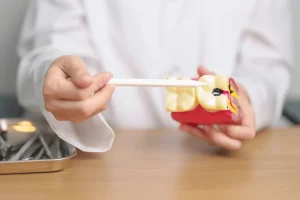
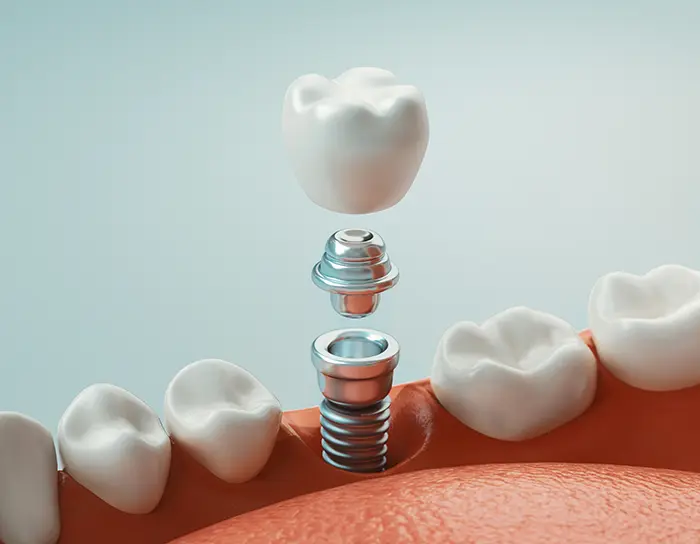
A dental implant is a small, biocompatible titanium (or zirconia) post that is placed directly into the jawbone, acting as an artificial tooth root. Once it has fused with the bone — a process called osseointegration — a custom crown, bridge, or denture is attached on top. Unlike a bridge, an implant doesn’t rely on neighbouring teeth for support, and unlike a removable denture, it stays firmly in place, letting you bite, chew, and speak with confidence.
Implants are widely considered the gold standard for replacing missing teeth because they preserve jawbone density (which shrinks over time when a tooth is missing), don’t require altering healthy neighbouring teeth, and can last decades with good care.
How much do dental implants cost in Streetsville & Mississauga?
Dental implant cost depends on how many teeth are being replaced, the type of restoration, and whether any preparatory work (like bone grafting) is needed. As a general 2026 guide for the Mississauga and Streetsville area:
- Single dental implant (post, abutment & crown): roughly $3,000 – $6,000 per tooth, depending on the case complexity.
- Implant-supported bridge (replacing several teeth): typically $6,000 – $15,000, depending on the number of implants and units required.
- Implant-supported full-arch denture (All-on-4 style): generally $15,000 – $30,000+ per arch, depending on materials and the number of implants placed.
- Bone grafting (if needed): an additional $300 – $1,200+ per site, only required when there isn’t enough healthy bone to support an implant.
These figures are general ranges, not quotes — the only way to know your exact cost is a consultation and X-ray so we can assess your bone and gum health. We always provide a clear, itemized treatment plan before any work begins, so there are never surprise costs.
Are dental implants covered by insurance or the CDCP?
Many Canadian dental insurance plans provide partial coverage for implants under “major restorative” benefits, though coverage varies widely from plan to plan — some cover the crown but not the implant post itself, or cap the annual benefit. We’re happy to review your policy and submit a pre-determination so you know exactly what’s covered before treatment starts.
The Canadian Dental Care Plan (CDCP) currently has limited coverage for implants, as it focuses primarily on preventive and essential restorative care — but eligible patients may still receive support for related procedures like extractions or exams. Our team keeps up to date with CDCP rules and will let you know exactly what applies to your situation. For patients without insurance, we also offer flexible payment plans to make implants more manageable.
The dental implant procedure: step by step
Getting a dental implant is a multi-stage process that typically unfolds over a few months, giving your body time to heal properly at each stage:
- Consultation & imaging. We examine your mouth, take digital X-rays (and a 3D scan if needed), and assess your bone density, gum health, and overall candidacy. This is when we build your personalized treatment plan and cost estimate.
- Tooth extraction (if needed). If the damaged tooth is still present, it’s gently removed. In some cases, an implant can be placed the same day as extraction; in others, we let the site heal first.
- Bone grafting (if needed). If there isn’t enough bone to anchor the implant securely, a small graft is placed and given time — usually a few months — to integrate and strengthen the jaw.
- Implant placement. The titanium post is precisely placed into the jawbone under local anaesthetic. Most patients describe this step as far more comfortable than they expected, similar to having a tooth extracted.
- Osseointegration & healing. Over roughly 3 to 6 months, the implant fuses with your jawbone, creating a stable, permanent foundation. A temporary restoration may be worn during this time.
- Abutment & crown placement. Once healed, a small connector (abutment) is attached, and your custom-made crown — matched precisely to your natural tooth colour and shape — is fitted on top.
- Follow-up care. We check your bite, comfort, and the health of the surrounding gum tissue, and set you up with a maintenance schedule to keep your implant healthy for years to come.
While the full process can take several months from start to finish, most of that time is simply healing in the background — the actual appointments are brief, and most patients return to normal activities the same or next day after each procedure.
Does getting a dental implant hurt?
Implant placement is performed under local anaesthetic, so you shouldn’t feel pain during the procedure itself. Afterward, it’s normal to experience mild swelling, tenderness, or bruising for a few days — most patients manage this comfortably with over-the-counter pain relief, and many say it’s less uncomfortable than a tooth extraction. We’ll give you detailed aftercare instructions, and our team is always just a phone call away if you have any concerns during healing.
Am I a good candidate for dental implants?
Most healthy adults with one or more missing teeth are good candidates for implants. Key factors we assess during your consultation include:
- Sufficient jawbone density to support the implant (or the ability to build it up with a graft)
- Healthy gums, free of active gum disease
- Good general health — conditions like uncontrolled diabetes or certain medications can affect healing, but don’t automatically rule out implants
- Non-smoking or willingness to reduce smoking around the time of treatment, since smoking slows healing and raises failure risk
Even if you’ve been told in the past that you’re not a candidate — for example, due to bone loss — advances in bone grafting mean many patients who were previously turned away can now receive implants. It’s always worth a fresh consultation to find out your options.
Dental implants vs. bridges vs. dentures
If you’re missing one or more teeth, you generally have three options, each with different trade-offs:
Dental implants. The most durable, natural-feeling option. They don’t rely on neighbouring teeth, preserve jawbone, and can last decades with proper care — but they involve a higher upfront cost and a longer healing timeline.
Dental bridges. A fixed option that replaces one or more missing teeth by anchoring a false tooth to the adjacent natural teeth. Faster and less expensive than implants, but it requires reshaping healthy neighbouring teeth and doesn’t stop jawbone shrinkage in the gap.
Dentures. The most affordable and least invasive option, either partial or full. Removable dentures are a practical solution for many patients, though they can shift while eating or speaking and typically need periodic adjustment or replacement — some patients later choose implant-supported dentures for a more secure fit.
There’s no single “best” option for everyone — the right choice depends on your budget, the number of teeth involved, your bone health, and your priorities. We’ll walk you through all three during your consultation so you can make a confident, informed decision.
How long do dental implants last?
With good oral hygiene and regular dental check-ups, the titanium implant post itself can last a lifetime — it’s one of the most durable restorations in dentistry. The crown on top typically lasts 10 to 15+ years before it may need replacing due to normal wear, similar to a natural tooth. Keeping up with cleanings, avoiding chewing on very hard objects (like ice), and not smoking all help maximize the lifespan of your implant.
Caring for your dental implant
A dental implant is cared for essentially the same way as a natural tooth:
- Brush twice daily with a soft-bristled brush, paying attention to the gumline around the implant
- Floss daily, using implant-specific floss or a water flosser if recommended
- Keep up with regular cleanings and check-ups so we can monitor the implant and surrounding gum tissue
- Avoid biting hard objects like ice, pens, or hard candy, which can damage the crown
- Wear a night guard if you grind your teeth, to protect both your implant and natural teeth
Because implants aren’t susceptible to cavities the way natural teeth are, the main thing to watch for is peri-implantitis — gum inflammation around the implant — which regular hygiene and check-ups help prevent.
Common myths about dental implants
We hear a lot of misconceptions from Streetsville patients before their first consultation — here’s what’s actually true:
Myth: Implants are only for older patients. In reality, implants are appropriate for most healthy adults, regardless of age, as long as jaw growth is complete and bone health is adequate.
Myth: The procedure is extremely painful. Implant placement is done under local anaesthetic, and most patients report mild discomfort afterward — often less than they expected, and far less than a severe toothache.
Myth: Implants are unaffordable for most people. While implants are a bigger investment upfront than a denture, financing options, insurance coverage, and the long lifespan of implants (often decades) make the true cost-per-year very reasonable compared to repeatedly repairing a bridge or denture.
Myth: Implants require special, complicated care. Beyond brushing, flossing, and regular check-ups — the same routine as natural teeth — implants don’t need any special maintenance.
Myth: You can’t get an implant if you’ve lost bone in your jaw. Bone grafting has made implants possible for the vast majority of patients who previously wouldn’t have qualified.
Financing options for dental implants in Mississauga
We know that paying for implants out of pocket can feel daunting, so we work with Streetsville and Mississauga patients to make treatment manageable:
- Insurance coordination. We review your plan, submit pre-determinations, and file claims directly where possible so you know your true out-of-pocket cost upfront.
- Phased treatment plans. For multi-tooth cases, treatment can sometimes be staged over time to spread out the investment.
- Flexible payment plans. We offer payment options so you’re not required to pay the full cost in a single visit.
- Transparent, written quotes. Every treatment plan comes with a clear cost breakdown before you commit to anything, so there are never surprise fees.
If cost has been the thing holding you back from replacing a missing tooth, we’d encourage you to still book a consultation — we can usually find an approach that fits your budget and timeline.
Signs you may need a dental implant
It’s not always obvious when it’s time to consider an implant, especially if you’ve been living with a gap or a failing tooth for a while. Common signs Streetsville patients bring to us include:
- A missing tooth you’ve been putting off replacing — even an old gap can benefit from an implant, since bone loss continues the longer a tooth is missing
- A tooth that’s cracked, badly decayed, or infected beyond repair, where extraction and replacement is the healthier long-term option
- A loose or failing bridge that keeps needing repair or no longer fits well
- A denture that shifts, clicks, or feels unstable while eating or speaking
- Difficulty chewing certain foods on one side of your mouth because of a missing tooth
- Self-consciousness about a visible gap when you smile or laugh
If any of these sound familiar, it’s worth booking a consultation — even if you’re not sure implants are right for you yet. We’ll give you an honest assessment of your options, with no pressure.
What to expect at your first implant consultation
Your first visit is all about information, not commitment. Here’s what typically happens when Streetsville patients come in for an implant consultation at Eglinton Oak Dental:
- A conversation about your goals. We start by understanding what’s bothering you — whether it’s function, appearance, comfort, or all three — and what result you’re hoping for.
- A thorough oral exam. We check the health of your remaining teeth, gums, and the site where the implant would go.
- Digital X-rays or 3D imaging. This lets us see your jawbone density and structure precisely, which is essential for safe, accurate implant planning.
- A personalized treatment plan. We walk you through your options — implant type, whether grafting is needed, expected timeline, and a clear cost breakdown.
- Time for your questions. Nothing is rushed — we want you to leave feeling confident about your decision, whatever you choose.
Most consultations take under an hour, and you’ll leave with a clear picture of your options and costs — no guesswork.
Life after dental implants: what changes
Patients who complete implant treatment consistently tell us the same things: they can eat foods they’d avoided for years — apples, corn on the cob, nuts — without a second thought. They stop covering their smile in photos. They forget the implant is even there, because it feels and functions like a natural tooth. For many Streetsville patients, replacing a missing or failing tooth isn’t just a dental decision — it’s a quality-of-life one, restoring the confidence to eat, speak, and smile freely again.
Serving Streetsville and the surrounding Mississauga neighbourhoods
Eglinton Oak Dental is proudly located at 3960 Eglinton Avenue West, Unit 12, with free on-site parking — an easy, direct drive from Streetsville, whether you’re coming from Britannia Road, Mississauga Road, or the Streetsville GO area. We also welcome patients from Erin Mills, Central Erin Mills, Churchill Meadows, Meadowvale, and Sheridan. Many of our Streetsville patients tell us they appreciate having a modern, full-service dental clinic close to home instead of driving further into the city for specialized treatment like implants.
Frequently asked questions about dental implants in Streetsville
How much do dental implants cost near Streetsville?
A single dental implant typically costs between $3,000 and $6,000 in the Mississauga area, including the post, abutment, and crown. Multiple-tooth cases and full-arch restorations cost more. Call 905-607-1112 for a personalized quote after your consultation.
How far is Eglinton Oak Dental from Streetsville?
We’re located at 3960 Eglinton Avenue West, Unit 12, just a short drive from Streetsville’s Main Street via Mississauga Road or Britannia Road, with free parking on site.
Are dental implants covered by insurance?
Many insurance plans offer partial coverage for implants under major restorative benefits, though coverage varies by plan. We’ll review your policy and submit a pre-determination so you know your exact out-of-pocket cost before treatment.
How long does the dental implant process take?
From consultation to final crown, the process typically takes 3 to 6 months, mostly for healing and osseointegration. Simple single-tooth cases can sometimes be faster, while cases needing bone grafting take longer.
Do dental implants look natural?
Yes. Your custom crown is shade-matched and shaped to blend seamlessly with your natural teeth, so most people won’t be able to tell you have an implant at all.
What if I don’t have enough bone for an implant?
A bone graft can rebuild the area over a few months, after which an implant can usually be placed successfully. Many patients who were told they weren’t candidates in the past are good candidates today thanks to grafting techniques.
Can you replace several missing teeth with implants?
Yes. Several missing teeth can be replaced with individual implants, an implant-supported bridge, or a full-arch option such as All-on-4. We recommend the best option after a 3D scan and exam.
What happens at a dental implant consultation?
We review your medical history, examine your mouth, take X-rays or a 3D scan to check the bone, explain your options and give you a written estimate. There is no obligation to go ahead.
How do I look after my dental implant?
Brush twice a day, clean between your teeth daily with floss, interdental brushes or a water flosser, and keep up regular checkups and cleanings. Implants cannot decay, but the gum around them can become infected if plaque builds up.
Is it safe to have an implant if I am nervous about the procedure?
Yes. The area is fully numbed, and sedation options are available for anxious patients. We take the time to explain each step before we start.