Root Canal Treatment in Mississauga: Cost, Procedure & Pain-Free Care (2026 Guide)
The words “root canal” make more people nervous than almost any other phrase in dentistry — yet most patients tell us afterward that it felt no different from getting a filling. If you are dealing with a throbbing toothache, sensitivity to hot or cold that lingers, or a dentist has flagged an infected nerve on an X-ray, a root canal treatment Mississauga patients trust can save the natural tooth and stop the pain, usually in a single comfortable visit. This guide covers what a root canal actually involves, how much it costs in Mississauga, what modern pain-free techniques look like, and how to know if you need one.
At Eglinton Oak Dental, our team performs root canal treatment using modern rotary instruments and local anesthesia so the procedure itself is virtually painless — call 905-607-1112 if you’re in pain and need to be seen quickly.
In Pain? Get Seen Quickly for a Root Canal Consultation
Rated 4.8★ by 320+ Mississauga patients. Fill in the quick form below and our team will call you back, or call 905-607-1112 now — we prioritize same-day appointments for tooth pain.
What is a root canal, and why is it needed?
Inside every tooth, beneath the hard enamel and dentin, sits a soft chamber of living tissue called the pulp — nerves, blood vessels, and connective tissue that helped the tooth grow. When deep decay, a cracked tooth, a failed old filling, or trauma lets bacteria reach that pulp, it becomes infected and inflamed, and because the pulp chamber is enclosed in hard tissue, that infection has nowhere to drain on its own. A root canal treatment Mississauga dentists perform removes the infected or dying pulp tissue from inside the tooth, thoroughly disinfects the empty canals, and seals them, stopping the infection and eliminating the pain at its source — all while keeping your natural tooth in place rather than extracting it.
The alternative to a root canal, once a tooth’s nerve is infected, is almost always extraction. Keeping your natural tooth matters more than people often realize: it preserves your ability to bite and chew normally on that side, keeps neighboring teeth from shifting out of position, and avoids the additional cost and time of a bridge, implant, or partial denture down the road. In the vast majority of cases we see, saving the natural tooth with a root canal is both the more comfortable and more cost-effective long-term choice.
Signs you might need a root canal
Not every toothache means you need a root canal, but certain symptoms are strong indicators that the nerve inside a tooth is infected or dying and should be checked promptly:
- Persistent, throbbing tooth pain that lingers or worsens, especially at night or when lying down
- Sharp sensitivity to hot or cold that continues for 30+ seconds after the stimulus is removed (brief sensitivity that fades in a few seconds is usually not a nerve issue)
- Pain when biting or chewing on a specific tooth
- Swelling or tenderness in the gums near a specific tooth, sometimes with a small pimple-like bump (a fistula draining an abscess)
- Tooth discoloration — a tooth turning noticeably darker or greyish compared to its neighbors, often a sign the internal nerve has died
- A cracked or chipped tooth from an injury or biting something hard, especially if pain follows
- An old, deep filling or crown that has started causing pain years after placement
Occasionally, an infected tooth causes no pain at all and is only caught on a routine X-ray — another reason regular checkups matter even when nothing seems wrong. If you’re experiencing any combination of the symptoms above, especially spontaneous or lingering pain, don’t wait; untreated infections can spread to the jawbone and become considerably more serious and expensive to treat.
What happens during a root canal procedure
A root canal at our Mississauga clinic is typically completed in one to two visits of about 60–90 minutes each, depending on which tooth is involved (molars have more canals than front teeth and take somewhat longer). Here’s what the appointment actually involves:
- Diagnosis and X-ray: we confirm the diagnosis and map the tooth’s root canal anatomy before starting
- Local anesthesia: the tooth and surrounding gum are thoroughly numbed — this is the same anesthesia used for a filling, and it’s what makes the rest of the procedure pain-free
- Isolation: a small rubber sheet (a dental dam) is placed around the tooth to keep it clean and dry during treatment
- Accessing the pulp: a small opening is made through the top of the tooth to reach the pulp chamber and canals
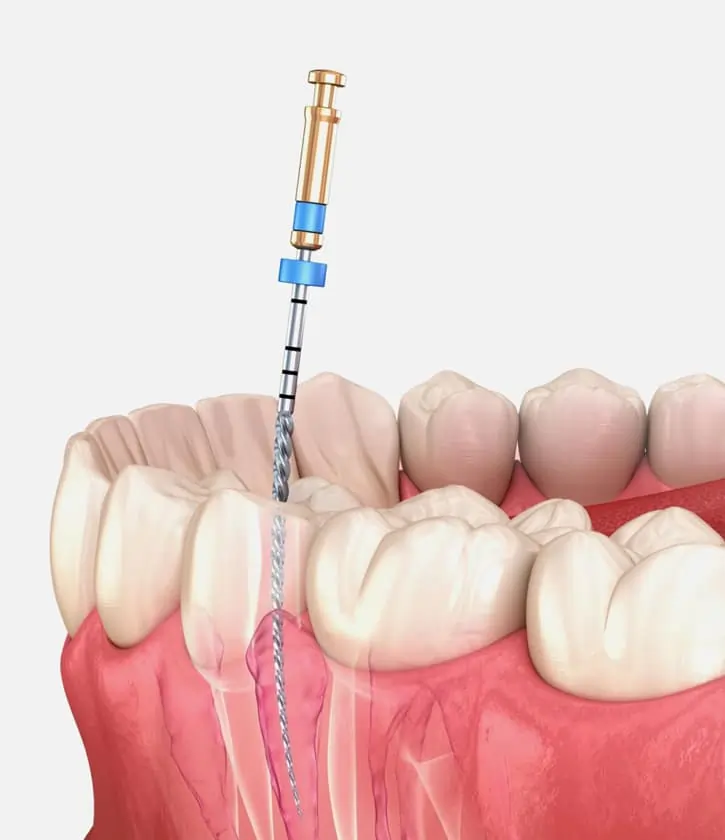
- Removing infected tissue: the infected or dead pulp is carefully removed using fine rotary instruments, and each canal is cleaned and shaped
- Disinfection: the canals are irrigated with an antibacterial solution to eliminate remaining bacteria
- Filling and sealing: the cleaned canals are filled with a biocompatible material (gutta-percha) and sealed to prevent reinfection
- Restoration: because a root-canal-treated tooth can become more brittle over time, most back teeth need a dental crown afterward for long-term strength; front teeth sometimes only need a filling
Throughout the procedure you’ll feel pressure and vibration from the instruments, but not sharp pain — if you feel anything more than pressure, tell your dentist immediately so more anesthetic can be given. Most patients are surprised at how uneventful the appointment feels once it’s underway, especially compared to the anxiety of anticipating it.
Does a root canal hurt?
This is, understandably, the question almost every patient asks first. The honest answer: the root canal procedure itself is performed under local anesthesia and should not hurt while it’s happening — patients often describe it as feeling similar to getting a routine filling. The pain people associate with root canals is almost always the pain of the infected tooth before treatment, which is exactly the pain a root canal is designed to relieve. Modern techniques, better anesthetics, and rotary instrumentation have made root canal treatment dramatically more comfortable than it was even a decade ago.
After the anesthetic wears off, it’s normal to have mild soreness or tenderness around the tooth for a few days, similar to the ache after any dental procedure, especially if there was significant infection beforehand. This is easily managed with over-the-counter pain relievers like ibuprofen, and most patients return to normal eating and daily activities within a day or two.
How much does a root canal cost in Mississauga?
Root canal cost depends primarily on which tooth is being treated, since molars have more canals (and therefore take longer and require more materials) than front teeth. As a general 2026 guide for Mississauga:
- Front tooth (incisor) root canal: roughly $600 – $900
- Premolar root canal: roughly $750 – $1,100
- Molar root canal: roughly $1,000 – $1,400
- Follow-up crown (usually needed on back teeth): roughly $1,000 – $1,600 additional
These figures roughly follow the Ontario Dental Association fee guide, though individual clinics may price slightly above or below it. We always provide a written estimate before starting treatment, broken down by procedure code, so you know the full cost — including the crown, if one is needed — before we begin.
Is root canal treatment covered by insurance or the CDCP?
Most employer dental insurance plans cover root canal treatment under “major” or “endodontic” services, typically at 50–80% after any deductible, though coverage percentages and annual maximums vary significantly by plan. We’re happy to submit a predetermination to your insurer before treatment begins so you know your out-of-pocket cost in advance.
If you don’t have private insurance, the Canadian Dental Care Plan (CDCP) covers eligible children, seniors, and adults holding a valid Disability Tax Credit certificate for many endodontic services, subject to income eligibility and the plan’s fee schedule — see our full CDCP coverage guide for details on eligibility and what’s included. For any portion not covered, we offer transparent estimates and flexible payment options so an infected tooth never has to go untreated over cost concerns — especially since delaying treatment usually makes the problem, and the eventual bill, worse.
Root canal vs. tooth extraction: which is better?
When a tooth’s nerve is infected, you generally have two options: root canal treatment to save the tooth, or extraction to remove it. In the large majority of cases, saving the natural tooth with a root canal is the better long-term choice, for a few key reasons:
- Chewing function: a natural tooth (even with a crown) chews more like your original tooth than any replacement
- Preventing shifting: extracting a tooth leaves a gap that neighboring and opposing teeth can drift into over months and years, potentially causing bite problems
- Long-term cost: a root canal plus crown is often less expensive overall than extraction followed later by an implant or bridge to fill the gap
- Faster recovery: root canal recovery is typically quicker and less invasive than a surgical extraction
Extraction is sometimes still the right call — if a tooth is severely fractured below the gumline, has inadequate bone support, or the root canal has a poor prognosis for other reasons. We’ll always walk you through both options honestly, including the pros, cons, and cost of each, rather than assuming one is automatically right for your situation.
What to expect after your root canal: recovery and aftercare
Recovery from a root canal is generally straightforward. Here’s what to expect in the days that follow:
- Mild soreness for 2–3 days, manageable with over-the-counter pain relievers like ibuprofen or acetaminophen
- Some tenderness when biting on the treated tooth until any swelling fully resolves
- Avoid chewing on the treated side until your permanent restoration (crown or filling) is placed, especially if only a temporary filling is in place
- Maintain normal brushing and flossing, being gentle around the treated tooth
- Book your crown appointment promptly if one is needed — an unrestored root-canal-treated back tooth is more vulnerable to fracture
Contact us right away if you experience severe pain, visible swelling of the face or gums, or a fever after treatment — while uncommon, these can indicate the infection needs further attention.
Can a tooth need a root canal more than once?
In a small percentage of cases, a previously root-canal-treated tooth can become reinfected years later — often due to a new cavity reaching the tooth, a cracked filling or crown letting bacteria back in, or complex canal anatomy that wasn’t fully sealed the first time. When this happens, a retreatment (redoing the root canal) can often still save the tooth, though in some cases a referral to an endodontic specialist for more complex retreatment or apicoectomy (root-tip surgery) may be recommended. Regular checkups and prompt attention to any new symptoms on a treated tooth are the best way to catch this early.
Root canals on children and teenagers
While less common than in adults, children and teenagers can occasionally need root canal treatment on a permanent tooth following a sports injury, deep untreated cavity, or trauma. Baby teeth with infected pulp are more often treated with a related procedure called a pulpectomy, which removes infected pulp tissue while preserving the baby tooth until it naturally falls out, maintaining space for the permanent tooth underneath. Our team is experienced at making these procedures calm and manageable for younger patients.
Common myths about root canal treatment
Myth: Root canals are one of the most painful dental procedures. In reality, root canals are performed under local anesthesia specifically to eliminate pain, and most patients report feeling no worse than a routine filling appointment. The pain people remember is almost always from the infection beforehand, not the treatment itself.
Myth: It’s better to just pull the tooth. Extraction is a valid option in some cases, but for most infected teeth, saving the natural tooth with a root canal preserves chewing function and bite alignment better and often costs less over the long run than extraction plus a bridge or implant later.
Myth: Root canals cause illness elsewhere in the body. This claim, based on discredited early-1900s research, has been thoroughly debunked by modern dental and medical research. Root canal treatment is a safe, well-established procedure performed millions of times a year worldwide.
Myth: You don’t need a crown after a root canal. For back teeth especially, skipping the crown significantly increases the risk of the tooth cracking under normal chewing forces, since the procedure removes some of the tooth’s internal structure.
Choosing the right dentist for your root canal
Most straightforward root canals on front teeth and premolars can be comfortably completed by a general dentist with modern training and equipment, as we do routinely at our Mississauga clinic. More complex cases — unusual canal anatomy, retreatments, or teeth with very calcified canals — are sometimes referred to an endodontist, a specialist focused exclusively on root canal therapy. We’ll always be upfront if we feel a referral gives you the best outcome, rather than attempting a case that’s better handled by a specialist.
Emergency root canal care in Mississauga
Severe, spontaneous tooth pain — especially pain that wakes you up at night, or comes with facial swelling — is a genuine dental emergency, and we prioritize same-day or next-day appointments for patients in this kind of pain. Getting seen quickly not only relieves your discomfort faster but also reduces the chance of the infection spreading further into the jaw. See our emergency dentist Mississauga guide for more on what qualifies as a dental emergency.
Serving Mississauga, Erin Mills, Churchill Meadows, Streetsville & Meadowvale
Eglinton Oak Dental provides root canal treatment to patients across Mississauga, including Erin Mills, Central Erin Mills, Churchill Meadows, Streetsville, and Meadowvale. Our Eglinton Ave W clinic offers same-day emergency slots for tooth pain, along with evening and Saturday appointments.
Why Choose Eglinton Oak Dental for Your Root Canal
An infected tooth won’t get better on its own, and the longer it’s left, the more painful and costly it typically becomes to treat. Our team uses modern rotary instruments, thorough local anesthesia, and a calm, unhurried approach so that a root canal treatment Mississauga patients might have been dreading turns out to be far more manageable than expected. Rated 4.8★ by more than 320 patients, we prioritize same-day appointments for anyone in dental pain. Call 905-607-1112 to get seen quickly.
Frequently asked questions about root canal treatment in Mississauga
Does a root canal hurt?
No — the procedure is performed under local anesthesia and should feel similar to getting a filling. The pain people associate with root canals is almost always from the infection beforehand, which the treatment relieves.
How much does a root canal cost in Mississauga?
Root canal cost typically ranges from $600 for a front tooth to $1,400 for a molar, plus roughly $1,000–$1,600 for a follow-up crown if one is needed.
How long does a root canal take?
Most root canals take 60–90 minutes and are completed in one to two visits, depending on the tooth and number of canals involved.
Is root canal treatment covered by insurance or the CDCP?
Most employer dental plans cover root canal treatment at 50–80% under major or endodontic services. Eligible patients under the CDCP may also have coverage, subject to income eligibility.
What’s the difference between a root canal and an extraction?
A root canal removes infected pulp tissue and saves the natural tooth, while extraction removes the tooth entirely. Saving the natural tooth is usually preferred for chewing function and long-term cost.
Do I need a crown after a root canal?
Most back teeth need a crown after a root canal for long-term strength, since the procedure can leave the tooth more brittle. Front teeth sometimes only need a filling.
Can a root canal fail or need to be redone?
In a small percentage of cases a treated tooth can become reinfected years later and may need retreatment, which can often still save the tooth.
Can I get a same-day root canal for severe tooth pain?
Yes, we prioritize same-day or next-day appointments for patients experiencing severe or spontaneous tooth pain.